
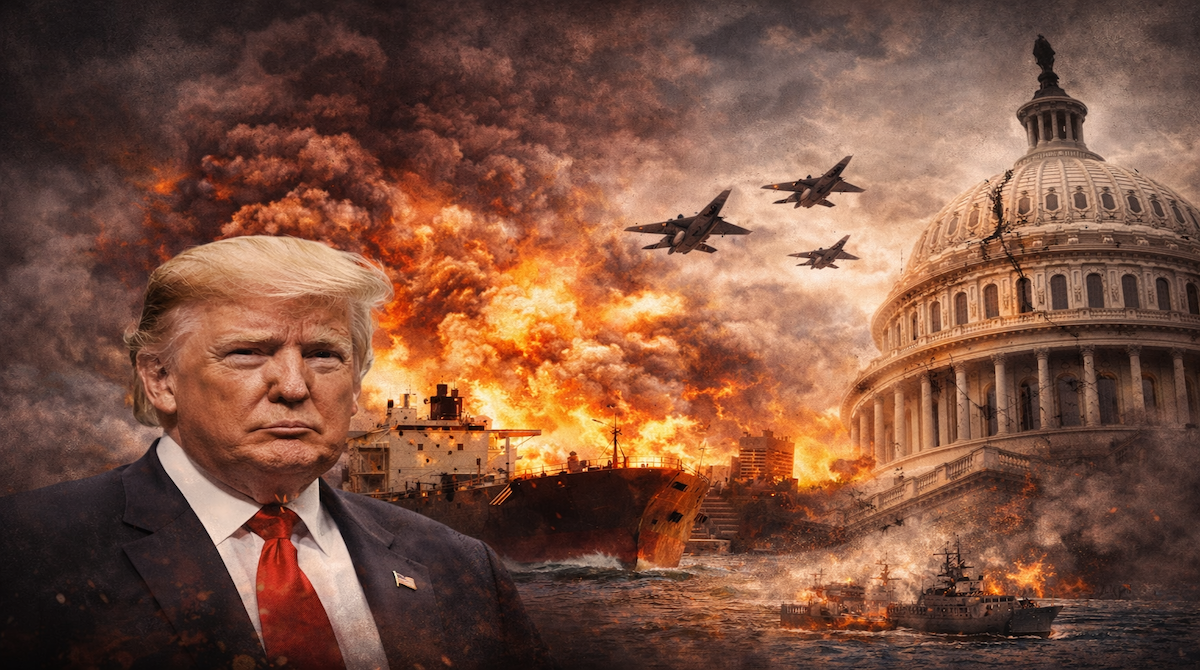
On the thirty-sixth day of the war, it is no longer possible to describe it as a “limited operation” or even a “regional conflict.” A war that began with the promise of rapidly paralyzing the power structure in Iran and imposing change from above has led neither to the collapse of the regime nor to the stabilization of the order sought by the United States. Trump’s recent speech—where he simultaneously claimed that objectives had been achieved while threatening to destroy infrastructure and “return Iran to the Stone Age”—reveals a power caught between declaring victory and escalating destruction. The shift from “precision war” to the open targeting of vital infrastructure is itself evidence of the failure of the initial project and the transition to a more brutal and unmasked phase of war.
This contradiction is not merely rhetorical. While claims are made about the complete paralysis of Iran’s military capabilities, coordinated attacks by Iran and its regional allies continue and the scope of the conflict is expanding. The gap between official narratives and the reality on the ground shows that declarations of victory are less a reflection of military superiority than an attempt to conceal a strategic deadlock.
This deadlock has rapidly spread into the structures of imperialist alliances themselves. Divisions within NATO, Europe’s refusal to directly enter the war, and threats to reconsider the alliance all point to a weakening of the United States’ ability to impose its will on its allies. What is being eroded is not merely a military alliance, but the entire architecture of the neoliberal global order built upon U.S. hegemony. A war that was meant to stabilize this order is now deepening the crisis within it.
In this context, the shift of the battlefield toward the Strait of Hormuz and energy infrastructures becomes decisive. The conflict is no longer about a single country or regime; it has reached a central node of global economic reproduction. Disruptions in energy flows, shocks to global markets, and rising living costs across the world demonstrate that war has become a link in the chain of global capitalist crisis—where destruction and instability function as mechanisms of crisis management.
Under these conditions, military escalation continues without a clear horizon. The deployment of new forces to the region, the growing readiness of certain Gulf states to participate in potential operations, and scenarios such as the occupation of strategic points indicate an expansion of the war into new fronts—not from a position of strength, but from the inability to secure decisive victory. In the absence of such a victory, what emerges is the attempt to construct a “performative victory”: from infrastructure destruction to limited high-risk operations. Yet this path risks pushing the war toward a more dangerous and uncontrollable stage.
At the same time, this war has not weakened the Islamic Republic; on the contrary, it has reinforced its mechanisms of repression and reconstituted its authority. War conditions provide a pretext for securitization, suppression of dissent, and the reorganization of coercive forces. A regime that had been shaken by deep social and political crises has, through war, regained temporary stability. This is one of the fundamental contradictions of imperialist wars: wars launched in the name of “liberation” ultimately reproduce the very structures they claim to oppose.
Meanwhile, a section of the Iranian right-wing opposition—better understood as a dependent neo-fascist tendency—has become an active propaganda arm of this war, backed by powerful Persian-language media networks such as Iran International. This current not only welcomes the bombing and destruction of the country’s infrastructure but openly aligns itself with war-making powers in an attempt to present itself as a political alternative. Here, even the traditional nationalist claim of “defending the nation” is abandoned and replaced by direct alignment with the war machine. This force operates as an extension of geopolitical and security agendas rather than as a movement for emancipation.
This war is not a conflict between forces of liberation, but a confrontation among the most aggressive factions of capital. The United States, the Israeli war machine, and the military-security structure of the Islamic Republic operate—despite their differences—within a shared logic: the reproduction of power through war, repression, and destruction. None represents the interests of the people. This is their war—not the war of the working class.
The United States now faces a structural dilemma: withdrawal would signify defeat and a weakening of its global position, while escalation risks widening the conflict regionally and beyond. In both scenarios, the result is not resolution, but the deepening of crisis. This war is less a demonstration of power than an expression of crisis at the center of imperialism and a sign of the erosion of U.S. hegemony within the global capitalist order.
Beneath this struggle of powers lies a brutal reality: the working class bears the cost of war. It is workers who are killed, displaced, impoverished, and forced to pay for the crisis through rising prices, unemployment, and social collapse—despite having no role in its making.
The response cannot lie in choosing between warring states. Neither the Islamic Republic nor imperialist powers represent the people. The only alternative is the construction of an independent, internationalist force capable of confronting this destructive cycle.
This requires building anti-war and anti-capitalist networks in workplaces and communities, linking struggles across Iran, the region, and the world, and transforming opposition to war into a material force capable of disrupting the war machinery of states.
If such a force does not emerge, war will not end—it will be reproduced in ever more destructive and expansive forms.
Towards anti-war and anti-capitalist organizing
Against all warring states—both domestic and imperialist
Against nationalism and neo-fascism
Long live internationalism
April 4, 2026
Internationalist Workers’ Organization (IWO)
