
A Power That Can Destroy, but Can No Longer Impose Order
The U.S.–Iran War in the Context of Capital’s Historical Crisis
The war in the Middle East has neither ended nor remained confined to the front on which the United States and Israel imagined it would unfold when they launched their attacks on Iran. Iran is under severe economic siege and continuing military attack; its oil exports and access to foreign currency have been badly damaged, while the pressure of the economic crisis on society continues to intensify. At the same time, the confrontation in the Strait of Hormuz continues, the fighting between Israel and Hezbollah has not ended despite Israel’s advances, armed groups close to Iran remain active in Iraq, and the advance of the Houthis in Yemen has turned Bab al-Mandab and Saudi oil routes into a new front of the conflict.

This situation contains a fundamental contradiction. The Islamic Republic is under mounting economic and military pressure, yet the United States and Israel have failed to convert that pressure into a decisive political outcome. A war that was supposed to settle the regional balance of power in their favour has instead spread across several fronts, while every attempt to close one route opens another arena of crisis.
Mohammed bin Salman’s call to Trump this week illustrates the situation well. Faced with the Houthi advance towards Bab al-Mandab and the attack on the East–West oil pipeline, Saudi Arabia called for direct U.S. military intervention. Trump’s answer was negative: intelligence and targeting assistance, yes; direct U.S. military intervention, for now, no.
Iran has not become more powerful than the United States, nor has America’s overwhelming military superiority disappeared. The issue lies elsewhere: the widening gap between America’s destructive power and its ability to transform that power into a stable political order is becoming increasingly visible.
Military Superiority, Political Inability to Impose an Outcome
The United States has destroyed large parts of Iran’s military and economic infrastructure and sharply restricted its oil exports, yet it has failed to overthrow the Islamic Republic. It has deployed a massive naval force in the region, yet it has not restored security in the Strait of Hormuz. One of its most important allies is demanding urgent assistance against the Houthis, while Washington hesitates to open yet another front.
This is not the end of American military power. It points to a deeper contradiction: the power of coercion remains immense, while the capacity to convert coercion into a stable political outcome has eroded.
A country’s infrastructure can be bombed, but the desired political order cannot necessarily be extracted from the ruins. A shipping route can be placed under military control, but this does not prevent the crisis from erupting along another route. Allies can be armed for decades, yet in a moment of crisis there is no guarantee that all of them can be protected simultaneously.
The old image of American omnipotence is cracking precisely here. Not because the United States has run out of bombs, warships or capital, but because a growing distance has emerged between the power to destroy and the capacity to organise order.
War, Elections and the Corruption of the Political Form of Rule
The U.S. electoral calendar has now become one of the determining variables of the war. Trump’s advisers are trying to prevent a major escalation before the midterm elections; rising petrol prices and the cost of war are directly tied to the Republicans’ electoral prospects. At the same time, the possibility of renewed escalation after the elections remains on the table.
In Israel too, the approaching elections have increasingly intertwined war with Netanyahu’s political survival. The image of the “strong leader,” the permanent invocation of an external enemy and the continuation of a wartime atmosphere have become part of the struggle to retain power.
Here, political corruption should not be understood merely as bribery or financial misconduct. The deeper issue is the erosion of the political apparatus’s capacity to concentrate the broader interests of the ruling class, while strategic decisions become increasingly tied to the survival of individuals, factions and short-term electoral calculations.
Under such conditions, the boundary between the so-called “national interest,” the interests of capital and the electoral survival of those in power becomes increasingly blurred. Decisions over whether to escalate or restrain a war, the price of oil and the lives of millions can become dependent on calculations about how an election a few weeks away will turn out.
The repulsive bullying language of Trump and Netanyahu is therefore not merely a matter of personal character. Threats, humiliation, ultimatums and the permanent performance of power correspond to a political form in which the old mechanisms of mediation are wearing away. The more the capacity to produce consent and organise order declines, the greater the role played by the display and exercise of coercive power.
The Islamic Republic Exploits the Cracks in the American Crisis
Capital’s Islamic regime in Iran is itself caught in a contradictory position. At home it faces accumulated social discontent and workers’ protests; abroad it is subjected to U.S. economic siege and military attacks. The Iranian economy is under enormous pressure, and the continuation of this situation can increasingly disrupt the foundations of its economic and social reproduction.
But the Islamic Republic does not necessarily need to defeat the U.S. fleet militarily in order to confront Washington. It is enough to raise the cost of continuing the war to the point where political and economic contradictions inside the United States, and among its allies, become sharper.
From this perspective, the Strait of Hormuz, the price of oil, attacks on Saudi oil infrastructure and the threat to Bab al-Mandab acquire an importance that goes far beyond their immediate military weight. Higher energy prices on the eve of U.S. elections can be transformed into domestic political pressure on the Trump administration. Washington’s refusal to enter directly into a war against the Houthis also shows that such pressures are not without effect.
The situation demonstrates how the reactionary states engaged in this war each seek to exploit to the maximum the political, economic and military crises confronting their opponents. Yet both the United States and Israel, which initiated this war, and the Islamic regime in Iran can sustain their policies only by transferring the cost of war onto the working class.
War Is Not a Consequence of Crisis, but One of Its Forms of Movement
At this point our analysis must break with the daily reporting of the war. War is not an external event that suddenly descends upon an otherwise normally functioning capitalist economy. In the historical crisis of the reproduction of capital as a whole, war itself becomes one of the forms through which crisis moves and is displaced.
When the ordinary mechanisms of the market and politics can no longer contain and displace the contradictions of reproduction without ever greater intervention, the state, credit, debt, sanctions, militarism and war enter directly into the mechanisms of reproduction.
Today the Strait of Hormuz is connected to petrol prices in the United States; Bab al-Mandab to inflation in Europe; the Saudi pipeline to the global energy market; military budgets to cuts in public services; and all of them, ultimately, to the wages and living standards of the working class.
In attempting to contain one political crisis, capital produces another crisis in economic reproduction, and then turns to greater state intervention, strategic reserves, military expenditure and intensified coercion in order to control its consequences.
This is the spiral that the concept of the historical crisis in the reproduction of capital as a whole must explain: the state and war are not external consequences of crisis, but active components in the management, displacement and intensification of its contradictions.
The Cost of War and the Power to Resist It
The working class is not merely the victim of war. The same class that is forced to pay its costs is also the force without whose labour the machinery of war cannot function.
In Iran, workers confront falling real wages, inflation, shortages and growing pressure on working conditions. In Lebanon, public-sector workers are protesting against attempts to transfer the cost of economic collapse and war onto their wages. In Israel, war has brought military mobilisation, rising living costs and the diversion of social resources into the war machine. In the Gulf states, a huge migrant workforce, largely deprived of direct political power, bears the consequences of economic disruption, insecurity and intensified state control. In the United States and Europe, the war reaches workers through energy prices, inflation, military budgets and cuts in public services. Yet another form of resistance is also emerging within these conditions.
An official trade-union statement against war may be politically significant, but it is not the same as the direct intervention of workers against the machinery of war. When dockworkers refuse to load or transport weapons, opposition to war moves beyond statements and moral protest and directly affects the circulation of capital and the logistics of warfare. This difference marks the boundary between a class-based anti-war movement and bourgeois pacifism.
An anti-war movement capable of confronting war in reality cannot restrict itself to asking governments to behave more “rationally.” The problem is not a shortage of reason among those in power. War arises from the very social relations these states exist to defend.
A working-class anti-war movement begins to take shape when opposition to the costs of war becomes connected to the independent power of workers in production, transport and social reproduction.
When a dockworker refuses to transport weapons, when an oil worker refuses to accept that production in a war zone justifies lower wages, and when public-sector workers refuse to pay for military budgets through falling living standards, a real breach opens in the false “national unity” imposed by states at war.
Such struggles do not yet constitute an internationalist anti-war movement. Independent political organisation of the working class remains weak, and genuinely internationalist forces are still scattered. But the social material for such a movement exists.
The task today is not to issue abstract calls for an anti-war movement from outside the class struggle. It is to connect the scattered forms of workers’ resistance and carry them from opposition to the costs of war towards confrontation with the machinery of war itself.
This is the point at which the struggle against war separates itself from pacifism and becomes part of the struggle against capitalism.
When Workers’ Anger Is Turned into a Force for the Far Right
An Analysis of the AfD Advance and the Political Mechanism for Disarming the Working Class in Germany
The far right’s victory in Saxony-Anhalt is being described as an “earthquake against democracy.” This description is itself part of the deception. It assumes that a healthy democracy existed and that some alien force suddenly attacked it from outside. But the AfD did not come from outside this order. It grew through elections, gained strength in parliament, and now makes use of the very machinery that for years has channelled workers’ anger away from the factory and the street and into the ballot box.

With nearly 44 percent of the vote, the AfD more than doubled its previous result and won 38 of 41 electoral constituencies. More striking still is the fact that 61 percent of workers voted for the party. This cannot be explained away with harmless phrases such as “economic dissatisfaction” or “protest against the established parties.” The real question is this: what kind of apparatus takes workers’ anger over rising prices, job insecurity, work intensification, war and the collapse of social services and turns it into votes for the most right-wing faction of capital?
The issue is not simply that the far right deceives workers. The deeper issue is that the entire political apparatus of capital had already disarmed workers of their independent class power before the AfD arrived.
The Worker in the Factory; the Powerless Citizen at the Ballot Box
At the workplace, the worker is not an isolated individual. The worker is part of a collective force that keeps the factory, the hospital, the railway, the school and society as a whole running. Workers’ power does not come from the ballot paper, but from their collective capacity to stop production and the circulation of capital. A strike is not merely an expression of dissatisfaction; it strikes at the very point from which the power of capital is nourished.
Representative democracy breaks up precisely this collective being. It separates the worker from fellow workers and transforms them, alongside the capitalist and the banker, into formally equal citizens. Inside the ballot box everyone has “one vote”; outside it, one owns the factory, the media and the bank, while the other is forced to sell labour-power. This juridical equality is a veil over class inequality.
Here protest does not disappear; it is rendered harmless. Struggle becomes electoral choice, organisation becomes delegation, and collective will becomes waiting for the next government. Factions change, but capitalist property, wage slavery and the state machine remain untouched. This is not an accidental flaw of democracy; it is its function.
When the Ballot Box Becomes a Market
What makes this mechanism even more naked is no longer confined to the German experience. On the eve of the U.S. midterm elections, Trump has promised that if the Republicans retain control of the House of Representatives and the Senate, every adult citizen will receive a $5,000 “dividend.” The White House itself has compared the proposal to a company distributing part of its profits among its shareholders.
The issue here is not merely whether such a promise legally constitutes “vote buying.” Its political significance lies in exposing the logic underlying bourgeois democracy: the voter becomes a customer, the election becomes a market in which parties compete, and the political relationship is turned into a transaction in which money can openly become one of the instruments.
The same worker whose power at the workplace arises from cooperation with other workers and from the ability to stop production becomes, in the electoral market, an isolated individual whose vote parties compete to capture through promises of cash, tax cuts, subsidies, fear of migrants or promises of “security.”
The form of the transaction differs from Trump to the AfD, but the mechanism is the same: social anger is removed from the terrain of collective struggle and transformed into an electoral demand that one faction of capital can appropriate.
For this reason, defending the same ballot box against the far right, without rebuilding the independent class power of workers, is no answer. The very apparatus that today tells workers to vote for the “democratic parties” in order to stop the AfD had already stripped them of their collective power and transformed them into isolated voters in the political marketplace.
Trade Unions and Parties: One Chain of Containment
This process does not begin on election day. At the workplace, official trade unions and works councils take hold of protest in order to turn it into harmless negotiation. Company profitability, the preservation of Germany’s competitiveness and keeping capital inside the country become the red lines of struggle. Workers are expected to give up wages and security so that capital does not suffer losses. This is the so-called “social partnership” that turns exploitation into a “shared responsibility” between worker and employer.
Tripartite agreements between the state, employers and trade unions are the respectable name for the same disarmament. Instead of extending protest, the union restricts its timing, form and scope and then imposes compromise on workers in the name of realism. When these compromises fail to stop poverty and insecurity, dissatisfaction remains, but it has lost its independent means of expression.
The parties of the right and left of capital continue the same work at the political level. Their differences concern how capital should be administered, not how workers can free themselves from capital.
None of them calls workers to independent struggle and organisation. All repeat the same message: leave it to the union, negotiate, wait, vote. They transform the militant worker into an obedient voter and then demand that this voter take responsibility for an electoral outcome whose conditions they themselves helped create.
The AfD does not stand at the beginning of this chain; it stands at its end. The worker separated from the class, contained by the union and wandering between parties becomes ready material for far-right politics.
The Far Right Steals Anger and Turns It Against Workers Themselves
The pressure on workers’ lives is real. Falling real wages, fear of unemployment, factory closures, rising energy prices and the transfer of the costs of war are not imaginary.
The strength of the AfD lies in the fact that it places its hand on a real wound, while concealing the cause of that wound. Capital gets up from the dock and gives its place to the migrant, the refugee, the Muslim, Brussels and the “Berlin elites.”
Racism in this politics is not merely prejudice or abuse. It is the organisation of competition among sellers of labour-power. Capital creates hierarchies among workers through citizenship, language, gender, type of contract and residency status. The far right transforms these divisions into hostility between “our own” and “the outsider.”
Instead of standing beside the migrant worker against capital, the German worker is encouraged to demand that the state make a fellow worker more rightless, poorer or expel them altogether. A force that could have threatened capital is turned against a part of itself.
The same inversion appears in the question of war. Sections of the working class oppose sanctions on Russia, high energy prices, the continuation of the war in Ukraine and rising military expenditure. Instead of turning this tendency into an independent struggle against all states and war camps, the unions and parties repeat the sermons of NATO and the German government.
The AfD steals this discontent and turns opposition to one imperialist orientation into support for another. The AfD is not anti-war; it demands a stronger German military and compulsory military service. The dispute is not about the interests of workers, but about which path should best secure the interests of German capital.
The Second Trap: Anti-Fascism in Defence of Capital
After the official parties and unions have blocked every path towards an independent working-class politics, they now appear in the role of saviours: “Set aside your differences and stand behind us in defence of democracy.”
The same forces that have imposed the costs of crisis and war on workers now make the growth of the AfD the guarantee for the continuation of their own rule.
Workers are thus trapped between two alternatives. The AfD says: direct your anger against migrants and place it at the service of the nation. The democratic parties say: place your fear of the AfD at the service of the state and parliament.
The first dissolves the worker into the nation; the second dissolves the worker into “democratic society.” Both demand that workers abandon their independent class existence.
Bourgeois democracy and fascism are not identical, but neither are they two opposed forms of class rule. Both are forms of the rule of capital.
As long as parliament, the unions and the circulation of parties are capable of containing workers, capital governs through the language of freedom and representation. When these instruments are no longer sufficient, the same class can turn towards the concentration of power, open repression and nationalist mobilisation.
An AfD victory does not yet mean the establishment of a Nazi regime. But the normalisation of ethnic scapegoating, the strong state and nationalist discipline politically prepares such a path.
Bordiga showed that bourgeois democracy defends capitalist order through indirect means, while open coercion enters the field when the legal containment of the proletariat is no longer sufficient.
Workers therefore cannot fight one form of capitalist rule by tying themselves to another. An anti-fascism that suspends the class struggle is not a barrier against fascism; it prepares the ground for its stronger return.
What Does the Workers’ Vote for the AfD Prove?
This vote does not prove that workers have somehow become fascists by nature. It shows how far the working class has been deprived of its own independent organisation.
A worker becomes part of a class when acting against capital on the basis of a common position in production. The same individual who, alone in the polling booth, sees himself as a threatened German can discover, in a strike, a common power with a migrant co-worker.
The figure of 61 percent is therefore, before it is a judgement on the character of workers, an indictment of the entire apparatus that has driven them away from collective struggle.
The anger exists. The desire for change exists. What is absent is an organised force capable of directing that anger against capital. It is precisely in this absence that the far right grows.
The Way Out Does Not Begin at the Ballot Box
The far right cannot be confronted by returning workers to the camp of the “democratic parties.” That is the same vicious circle that produced the AfD.
The rejection of parliamentarism is not a call for passivity or staying at home. On the contrary, it means returning politics to the place where workers actually possess power: the workplace, the strike, the mass meeting, the strike committee and direct networks linking centres of production and services.
Council-based organisation grows out of this collective power. In it, the representative is not a professional owner of other people’s will, but the elected and recallable delegate of a collective engaged in struggle.
Struggle against wage and legal hierarchies, unity between German and migrant workers, common resistance to dismissals and factory closures, and opposition to all camps of war attack the material foundations of nationalism and racism.
Either workers organise their anger independently against capital, or that same anger will once again be seized by one faction of capital and turned against workers themselves. There is no third way in the ballot box.
From Rojava to Damascus: The End of an Era of Kurdish Nationalism
The Integration of the SDF into the Syrian State and the Historical Test of “Democratic Confederalism”
The dissolution of the Syrian Democratic Forces—the SDF—as an independent military force, and the beginning of the integration of the military and administrative structures of northern and eastern Syria into the state of Ahmed al-Sharaa, represent far more than an organisational change in the balance of forces in Syria. This development marks the end of a historical period in the Kurdish nationalist movement: a period that began with Rojava’s self-administration and the slogan of “democratic confederalism,” developed into a military alliance with the United States during the war against ISIS, and finally, with a shift in the regional balance of power, ended in negotiations over the position of the Kurds within the Syrian central state.
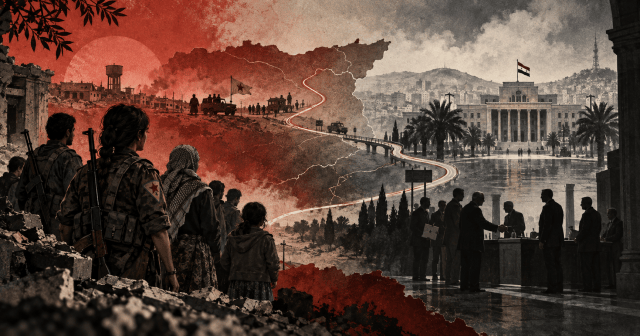
On 25 August 2026, the SDF officially announced the end of its independent military mission. Before this, an offensive by central government forces in January had removed from SDF control large parts of the territory it had held for years, including important oil fields, agricultural land and some facilities holding ISIS prisoners. The main military units are now being integrated into the Syrian army, while Sipan Hamo, one of the YPG commanders, has been appointed deputy defence minister responsible for the eastern regions.
But if this development is explained merely as the “surrender of the Kurds” or the “betrayal of the leadership,” its historical significance disappears. What is now taking place in Damascus is not a sudden accident but a point at the end of a long trajectory: from the project of an independent Kurdistan to democratic confederalism; from regional self-administration to reliance on American military power; and from there to integration into the Syrian central state.
From an Independent State to “Coexistence Without a State”
The PKK emerged in the late 1970s in an environment in which radical nationalism, guerrilla struggle and Stalinist models of “national liberation” dominated large sections of the Middle Eastern left. Its initial objective was the establishment of an independent Kurdistan with socialist claims. After the capture of Abdullah Öcalan in 1999, however, this perspective was gradually abandoned and replaced by the theory of “democratic confederalism,” influenced by the ideas of Murray Bookchin.
Öcalan criticised the nation-state and proposed local councils, self-administration, feminism and social ecology as elements of a different social order. The earlier analysis of the PKK by the Internationalist Workers Organisation focused precisely on this point: criticism of the nation-state, when it is not extended into a critique of class relations and capitalist property, does not necessarily lead beyond capitalism. It can instead lead to the search for a decentralised form of coexistence within those same social relations.
The Rojava experience created the historical possibility of testing this theory. As the Assad state’s authority collapsed in northern Syria, the PYD and YPG established structures of local self-administration. Councils emerged, women’s participation increased dramatically, and the Women’s Protection Units, the YPJ, became one of the best-known symbols of the struggle against ISIS.
These realities cannot simply be erased by a general judgement on “nationalism.” Thousands of Kurdish and non-Kurdish men and women died fighting ISIS, and parts of society genuinely experimented with forms of social organisation that differed from the reactionary order dominating much of the region.
But the Marxist question begins precisely here: on what material foundation did these institutions rest, and within what balance of power did they exist?
Rojava and the Contradiction of the Alliance with the United States
Rojava’s expansion was not solely the product of its own internal strength. From 2014 onwards, the YPG became the main backbone of the SDF, which in turn became the United States’ most important ground ally in the war against ISIS in Syria. American military, air and logistical support made possible the expansion of SDF-controlled territory to the point where, for a period, it controlled more than a quarter of Syrian territory, including oil-producing regions and large predominantly Arab areas.
It was here that the central contradiction of the project became visible. A movement claiming to have created an alternative to the nation-state and the imperialist order became increasingly dependent for its survival on one of the decisive powers of that same order.
This relationship cannot simply be explained as a “temporary tactic.” A tactic can maintain its independence only when there is an independent force behind it. But when territorial security, arms, air cover and the overall balance of forces depend upon the support of a great power, that power ceases to be merely a tactical ally and becomes one of the determining elements shaping the movement’s political horizon. Current developments have laid this limitation bare.
Following the fall of the Assad government and the change in U.S. policy towards Syria, Washington rapidly expanded its relations with Ahmed al-Sharaa’s government. In January 2026, the U.S. representative in Syria stated that the principal mission that had once made the SDF indispensable to Washington had largely come to an end. Several months later, the Trump administration removed Syria from the list of state sponsors of terrorism and lifted important barriers to international investment in Syria. One day after that decision, the official dissolution of the SDF was announced.
The same power that armed the SDF yesterday today supports the reconcentration of power in a state that is Turkey’s principal ally in Syria.
This is not some extraordinary “American betrayal.” It is the normal logic of imperialist politics. Great powers do not have permanent allies; they have changing interests and changing alignments. Any force that ties its political independence to their support will sooner or later itself become part of their negotiations and deals.
From the March Agreement to the January Offensive
The present integration did not suddenly begin in August 2026. On 10 March 2025, Mazloum Abdi and Ahmed al-Sharaa signed an agreement under which the civilian and military institutions controlled by the SDF, together with border crossings, the airport, and the oil and gas resources of the northeast, were to be transferred into the structures of the Syrian state.
From the beginning, the central dispute concerned the form of military integration. The SDF wanted to enter the Ministry of Defence as an organised bloc, while Damascus insisted upon the dissolution of its independent military structure and the concentration of arms in the hands of the central state.
This dispute continued for almost a year, until al-Sharaa’s government used military force in January 2026 to seize extensive areas of the northeast. With the rapid retreat of the SDF, the balance of negotiations changed fundamentally. An agreement that in March 2025 could still be presented as a bargain between two armed powers became, after January 2026, negotiations over the conditions under which a force that had lost most of its territory and economic leverage would be integrated into the state. It is here that “Rojava exceptionalism” confronted the real test of the state.
The State Returns
“Democratic confederalism” was supposed to demonstrate that politics could be organised beyond the nation-state. Today, however, the borders, airport, oil and gas resources, armed forces and administrative apparatus of the northeast are once again coming under the authority of the central state.
From a class perspective, the issue is not simply the replacement of one flag on government buildings by another. The new state is seeking once again to concentrate organised coercion, economic resources, taxation, borders and the region’s labour force within a single political centre. It is precisely here that the limitations of self-administration separated from social revolution become visible.
A council can be a form of independent workers’ power. But a council is not “revolutionary” simply because it is called a council. If property relations, wage labour, the market, military power and the structure of the state remain intact, local institutions can themselves become lower levels in the administration of those same social relations.
The difference between a council of workers’ power and an institution of local self-administration does not lie in their administrative form. It lies in their relationship to class power, property and the state. Rojava never resolved this question. With the return of central state authority, the contradiction is no longer theoretical but material.
Women: A Clear Test of Compromise
No sphere reveals this contradiction more clearly than the position of women. During the war against ISIS, the YPJ was not merely a military unit but an international symbol of the Rojava experience. The organised participation of women in political and military structures was one of the principal reasons supporters of “democratic confederalism” presented it as a historic alternative in the Middle East.
Yet this achievement is now itself endangered in the negotiations over integration with the central state. The issue goes far beyond the fate of a particular military unit. It shows how social achievements that lack an independent class and social power capable of defending them can, when the geopolitical balance changes, become objects of negotiation.
Women’s rights, the Kurdish language, forms of local administration and even the position of the armed forces are now on the negotiating table between Kurdish leaders and a government that is itself the product of another reactionary rearrangement produced by the Syrian war.
”Neither “Betrayal” nor “Historic Victory
Two simplified narratives are emerging around these developments. The first presents integration as a “victory of reason” and the beginning of Syrian national unity. Turkey has also welcomed the dissolution of the SDF and described it as a step towards the “unity of Syria.” For Ankara, the elimination of an independent YPG military structure has been one of the central objectives of years of Turkish military intervention in Syria.
The second narrative, coming from sections of Kurdish nationalism, may seek to explain every retreat purely through “American betrayal” or compromises made by the leadership. Both narratives conceal part of the reality.
The integration of the SDF is not merely the result of decisions made by a handful of leaders. It is the outcome of a historical strategy that based liberation not on the independent class power of workers and labouring people throughout the region, but on national autonomy, a separate armed force and manoeuvring among states and great powers. But this conclusion does not invalidate the demands of the Kurdish people.
National oppression, bans on the Kurdish language, deprivation of citizenship, discrimination, forced displacement and military repression are historical realities. Nor can the new Syrian state erase this history merely by invoking “national unity.” The real question is precisely this: how can the struggle against national oppression free itself from the captivity of nationalism?
The Working Class Outside the Bargaining of States
From an internationalist perspective, Kurdish workers do not face only two alternatives: seeking protection from the United States and a Kurdish nationalist force, or submitting to the Syrian central state.
The Kurdish, Arab, Turkish, Assyrian or Armenian worker, before belonging to any ethnic bloc, lives within the same social relations that condemn workers to the sale of their labour-power, poverty, war and repression. National and ethnic divisions are real, but capital and states constantly reproduce those divisions in order to organise competition within the working class.
In Turkey, decades of war between the state and the PKK liberated neither Kurdish workers nor Turkish workers. The Turkish state used nationalism to repress the Kurds and mobilise Turkish workers; Kurdish nationalism, in turn, repeatedly buried the class contradiction beneath the conflict between nations. Nor can the alternative in Syria be the replacement of one national flag by another.
If local councils are to mean something more than local administration, they must become independent of party apparatuses and the state, take root in workplaces and communities, elect recallable delegates, and connect themselves to a network of working-class struggles throughout Syria and the wider region.
The defence of the Kurdish language, resistance to ethnic discrimination, the defence of women’s rights and opposition to repression by the central state can move beyond the horizon of nationalism only when they are connected to the struggle against exploitation, capitalist property and all the states of the region.
What Remains of Rojava?
The Rojava experience should neither be turned into a myth nor erased. Thousands of people fought and lived through that experience, experimented with forms of self-organisation, and women acquired a social position that was unprecedented across much of the region. These were real experiences and can themselves become subjects of study and criticism for the workers’ movement. But what survives from a historical experience is not only what its leaders said about it. What happens in the test of power is also part of its truth.
And today’s test is clear: a movement that claimed it would move beyond the nation-state is now negotiating its position within a central state; a force whose autonomy had been secured by American arms is giving up its independent military structure after Washington changed its policy; and achievements once presented as “irreversible” are now subjects of negotiation with the government in Damascus. This is not the defeat of a people. Nor is it the defeat of the Kurdish people’s struggle against oppression. It is the crisis of a strategy.
A strategy that imagined a stable space for liberation could be created among the states of the region and the imperialist powers without breaking capitalist social relations.
The experience once again confronts the workers’ movement of the region with an old conclusion: every gain for which no independent social force has been organised to defend it can tomorrow be placed on the negotiating table of states.
The liberation of Kurdish workers and labouring people does not pass through Washington, Ankara or Damascus. Nor does the liberation of Arab, Turkish or Iranian workers pass through their “own” state.
There is another path: building independent class power, connecting the struggle against national and gender oppression to the struggle against exploitation, and transforming the council from a form of local administration into a genuine instrument of working-class organisation and power. If Rojava has a lesson for the future, it lies not in mythologising the past, but in understanding this historical limitation.
Towards the Reconstruction of Proletarian Internationalism – Part Three
Revolution, Councils and the Party: The Rupture in the Science of Class Struggle
In the previous part of this series, we argued that communism was a movement before it became a science. But this proposition must be taken one step further: even when communism produced its own science of class struggle, it did not separate itself from the movement. Communist science did not emerge outside the workers’ movement and then come to guide it from without. It took shape on the basis of the emergence and development of that very movement.

Marx did not begin from zero. Some of the concepts and problems of communism before him had already emerged within egalitarian, communist and workers’ movements. Another part of his theoretical framework was developed through the critique of philosophy, science and, above all, the political economy of bourgeois society. But this critique did not take place in an intellectual vacuum either. From the outset, Marx’s central concern was a society in which class struggle had become an independent historical force.
The Communist Manifesto was not the product of an isolated intellectual reflecting on an ideal future society. It was written out of the development of a real organisation, the Communist League, and within the context of the European workers’ and communist movement. Theory there was an attempt to historically concentrate the experience and orientation of a movement that already existed.
The Paris Commune offers an even clearer example. Marx did not possess a complete and predetermined theory of the political form of workers’ power that the Commune merely put into practice. The experience of the Commune itself developed Marx and Engels’ understanding of the state and political power. Here the movement was not merely the object of theory; it participated in the production of theory.
Even Capital cannot be understood simply as a work about “economics” in the conventional sense of the term. Its central concepts are reconstructed around the relation between capital and wage labour: necessary labour and surplus labour, surplus value, the rate of exploitation, the length of the working day, the intensity of labour, accumulation, the concentration of capital and the reproduction of class divisions. In the analysis of the working day, machinery, the factory and accumulation, the actual struggles of workers constantly enter into the very construction of the theory.
From this perspective, Capital is not only a critique of political economy; it is one of the most fundamental works of the science of class struggle.
The same relationship can be seen in many of Marx’s political writings. The revolutions of 1848, the Paris Commune, the struggles within the First International and developments in the workers’ movement constantly put theory to the test, corrected earlier concepts and posed new problems.
The historical process should therefore not be represented as though the workers’ movement first existed and the “science of Marxism” was then added to it from outside.
On the contrary, the scientific development of the workers’ movement—before Marx, in Marx, and after him—was part of the development of the movement itself.
The experience of struggle produced problems; theory concentrated and generalised that experience; organisation transformed it into historical memory and political programme; and theory was then tested and corrected again in the field of struggle.
Communism was a movement before it became a science; and when it produced the science of class struggle, it still remained a movement. The rupture began when this science was separated from the living process that had produced it.
When the Science of Class Struggle Became “Science”
After Marx and the decline of the First International, the conditions for this separation gradually took shape. Alongside the advance of the sciences in the second half of the nineteenth century and the rise of positivism, a particular conception of science became dominant: science as objective, specialised knowledge independent of the subject whose reality was being investigated. The social sciences increasingly sought to define themselves according to the same model.
This development was accompanied by changes within the workers’ movement itself. The communist current that during the First International had been directly engaged in the theoretical and practical battles of the movement weakened. At the same time, party, press, educational and parliamentary apparatuses expanded, while the weight of intellectual strata and middle layers in the production of theory increased.
Within this context, the relationship between science and movement also changed. In the theories of Kautsky and Plekhanov, Marxism increasingly became a science of the “laws of social development.” History acquired an evolutionist direction: capitalism develops according to its internal laws, its contradictions intensify, crises emerge, and the conditions for the transition to socialism arise.
In its extreme form, this perspective could transform the crisis of capital into an indication of its approaching inevitable collapse—as though history itself would perform the task that only class struggle could bring to completion. But the more important consequence of this transformation concerned the very conception of knowledge.
If Marxism is a science like other sciences, then its production also belongs to the specialists of that science. The working class is the historical object of this science and the material force through which it is realised, but scientific knowledge of the laws of society is produced somewhere outside its direct experience. From here a new separation became possible: the workers’ movement on one side and the science of socialism on the other.
Lenin, at one stage, also accepted this formulation of Kautsky and Plekhanov: socialist consciousness could not arise solely from the spontaneous struggles of workers and therefore had to be brought into the movement from outside.
Thus the issue was not merely a particular theory of the party. The epistemological foundation of the rupture had taken shape: the practice and experience of the class on one side of the process, the production of science on the other, and the party as the mediator through which that science was to be transmitted to the movement. The Second International transformed this separation into an organisational and material reality.
The trade union took responsibility for economic struggle, the party for politics, the parliamentary representative for parliament, and the theoretical apparatus for the production of “science.” The organisation that should have been the site where the experience of the movement was concentrated increasingly became an apparatus independent of the movement’s real development. 1914 was the moment when this rupture could no longer be concealed.
Internationalism existed in resolutions and programmes; but when war began, the main body of the Second International lined up behind its respective national states. What had been separated over several decades at the levels of knowledge, organisation and practice now became a historic political defeat.
October: The Process Opens Again
The Russian Revolution revealed another possibility in the face of this collapse. The soviets were not the product of a theory that the party had designed in advance. They emerged from the real struggles of workers and soldiers. The movement produced a new organisational form, and this very experience placed the theory and politics of the revolutionary forces themselves under examination.
The historical importance of the Bolsheviks lay not simply in possessing the “correct programme.” At a decisive moment, the party itself was compelled to learn from the revolution, revise its positions and concentrate the real movement of the class around the question of political power.
For a brief period, what had been separated during the preceding period once again drew closer together: the practice of the class, political organisation and the production of theory. But this process could not be sustained within a single country.
The October Revolution understood itself as the beginning of world revolution. The failure of the revolution to spread into Europe, and especially the defeat of the German Revolution, isolated Russia under conditions of civil war, blockade, economic collapse and the retreat of the workers’ movement.
As workers’ independent activity declined and the soviets weakened, the weight of the party and the state apparatus increased. Lenin’s conception of the role of the party also contributed, under these conditions, to a strengthening of the concentration of power, while the acceptance of the system of one-man management in production was one expression of this transformation.
Rosa Luxemburg’s warnings against bureaucratic centralisation acquire their historical significance precisely here. The issue was not merely the restriction of “democracy.” Restricting the independent activity of the masses also meant weakening the very process through which new experience, political initiative and revolutionary knowledge were produced.
Germany: Rupture at the Heart of the Revolution
In the German Revolution, the crisis in the relationship between movement, knowledge and organisation appeared in an even more naked form.
Mass strikes, the sailors’ revolt and the workers’ and soldiers’ councils demonstrated that the class was capable, in the course of struggle, of producing new forms of organisation and power. Yet precisely at the moment when the question of power became a practical question, the revolutionary movement itself confronted a fundamental polarity.
One pole, drawing on the experience of the spontaneous movement and the power of the councils, became suspicious of centralised political organisation. The experience of the Social Democratic apparatuses and their role in containing the movement reinforced this suspicion. The other pole emphasised the communist programme as science and the party as the embodiment of class consciousness and the centre of revolutionary leadership.
These two poles should not be understood as two independent errors or merely two competing theories of organisation. They were two expressions of the same rupture.
On one side stood the movement and the living experience of the class without sufficient political and theoretical concentration; on the other, an organisation and a science that risked defining themselves independently of the process through which knowledge was produced within the movement itself.
In the midst of the German Revolution, the rupture that had developed over preceding decades in the conception of science, consciousness and organisation became a political polarisation within the communist movement itself. For this reason, the dualism between party and council, or between party and spontaneity, was not the starting point of the problem. This dualism was itself the product of the rupture in the process of producing the science of class struggle.
The Defeat in Germany, the Retreat in Russia
The defeat of the German Revolution was not merely the defeat of a national revolution. It also weakened the possibility of breaking the Russian Revolution out of its isolation.
In Russia, war, blockade, economic crisis and the retreat of the workers’ movement created conditions in which the party and the state increasingly assumed tasks that should previously have been performed through the independent activity of the soviets and the class itself.
In Germany, by contrast, sections of the communist movement moved from the experience of party apparatuses and revolutionary defeat towards an increasing distrust of the party and of political centralisation. The two poles of the rupture therefore reproduced one another
On one side, the idea was strengthened that the communist programme and communist consciousness were concentrated in the party and that the party could act in the name of the class. On the other, the idea emerged that the spontaneous movement and the councils could find the road to revolution without independent political and theoretical concentration. But neither resolved the original problem.
The science of class struggle cannot be knowledge that a party apparatus or a group of specialists possesses and transmits to the class from outside. At the same time, the direct and spontaneous experience of struggle cannot by itself concentrate within itself the historical memory of earlier struggles, the experience of defeats and the general conditions of the global struggle.
The problem was not the relationship between two separate things; it was the process that had to transform them into different moments of a single production of knowledge.
The Rupture Was a Historical Process
From this perspective, the crisis of 1914–1923 was not a series of isolated events. The rise of positivism and the transformation of the concept of science, the weakening of the communist current after the First International, the growing weight of intellectuals and specialists, the transformation of Marxism into a science independent of the practice of the class, the evolutionism of Kautsky and Plekhanov, the theory of bringing consciousness from outside, the growth of party and trade-union apparatuses, the collapse of the Second International, the polarisation of the German Revolution and the retreat of the soviets in Russia were all links in a single process.
A process in which the living relationship between the movement of the class, the production of knowledge, political organisation and the development of the science of class struggle gradually broke apart. October briefly revealed the possibility of reconnecting these elements; the defeat of the European Revolution separated them again.
On one side emerged an organisation carrying within itself the danger of substituting itself for the movement; on the other, a movement that, in reaction to this substitution, could deny the necessity of political organisation and theoretical concentration. This crisis remained with the communist movement throughout the twentieth century. The question was not a choice between party and council, nor between organisation and spontaneity.
The question was the reconstruction of a process in which the living practice of the class, political organisation and the production of the science of class struggle could once again become different moments of a single movement. This question was not resolved. And it is precisely from here that the discussion on the reconstruction of proletarian internationalism must continue
