
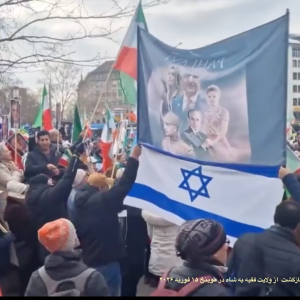
The brutality of the Islamic regime and the present state of emergency have confronted millions who fled the Islamic hell with a scene once imaginable only in nightmares: the merciless killing of their loved ones in Iran’s streets and cities – streets turned by Islamic executioners into arenas of a bloody and one-sided war, a war of armed forces against defenseless youth, against a people whose only “crime” is to stand against humiliation, poverty, and despotism.
In such a situation, millions in the Iranian diaspora, in their first human and instinctive reaction, extend their hands toward global powers in the hope of immediately stopping the machinery of crime: to prevent assaults on hospitals, to stop the hunting of the wounded, to end arrests and executions, to halt the apparatus whose snipers shoot children in head and chest and pile half-dead bodies in Islamic slaughterhouses.
This appeal is not primarily born of illusions about the “liberating nature” of world powers, but of two parallel processes: on one side, the tireless efforts of global powers to exploit the protest uprising as a geopolitical tool in proxy wars; on the other, the anxiety and desperation of layers turned into foot soldiers of proxy groups and the Iranian nationalist neo-fascist movement.
Thus the catastrophe of mass killing and collective captivity becomes not the starting point of organization from below, but a pretext for alignment from above. The historical tragedy begins precisely here: where real anger, in a blind revolt, becomes political capital for projects of power.
What is happening in Iran today is, in its political logic and possible outcome, not unlike 1979. Then too, a massive anti-despotic movement, instead of relying on the organized power of the workers’ movement, rallied behind the banner of the clergy and political Islam under Khomeini. Supported by international balances and guarantees to preserve the existing administrative and military apparatus and keep economic arteries open, repression and massacres began immediately after power was secured.
Today, amid repression and a profound crisis, the tragedy of 1979 is repeated – this time moving from the banner of Velayat-e Faqih to the banner of the Shah. Society is hurled from one despotism into another without moving closer to social liberation. A large part of the angry masses risks again turning its explosive energy into raw material for the reconstruction of capitalist order and the reproduction of oligarchies, mafias, and networks of power.
The reason for this repetition is not merely political cunning or media power, but the historical defeats of the working class and the absence of an independent class politics. Previous waves of uprising, despite their radicalism and the relative organization of workers, retirees, teachers, and students, did not lead to the formation of an independent progressive alternative or lasting working-class organizations – especially among women, who played a decisive role. This is inseparable from the absence of an independent working-class policy and a class party.
Under these conditions, a historical tragedy is unfolding: from street massacres and hidden graves to warships moving toward Iran with cries that “help is on the way”; from magnificent uprisings turned into blind revolt before the regime’s military machine to the use of people’s blood to architect a new regional order and construct proxy scarecrows of capital.
The tragedy also lies in the fall from desperate cries for help into empty reactionary slogans of “Long live the Shah” and a nationalism that wants to carry the voice of the slaughtered to Trump and Netanyahu – as if freedom falls from the sky, as if liberation is delivered by war rooms and warships.
The warships sent toward Iran must be understood within the evolution of U.S. policy in the Middle East. After Iraq and Afghanistan, the world is no longer one of large, costly wars but of cheaper operations, crippling sanctions, information warfare, and limited yet decisive strikes. What is advertised as “support for the Iranian people” continues this policy: shifting balances of power and securing future markets for capital without heavy costs. For the U.S. state and factions of global capital, the principle is shared: shape the region so no rival can challenge their order. Warships carry not freedom but geopolitical pressure.
Media propaganda attempts to reverse this truth and present the war machine as aid to protest movements. Yet the region’s history shows that whenever great powers “help,” it means rearranging power relations and rebuilding capitalist order under a new face.
The way out of the present deadlock lies neither in joining war nor in joining bargains. It lies in building what is absent: an independent working-class pole, an independent class politics, and organization from below. Only the class that carries the arteries of economic and social reproduction can paralyze repression and delegitimize foreign intervention. A general strike, linking social and political struggle, building anti-war and anti-capitalist nuclei in workplaces and communities, and transforming scattered anger into class power is the only horizon capable of stopping this tragedy.
Internationalist Workers’ Organization (IWO)
15 February 2028