
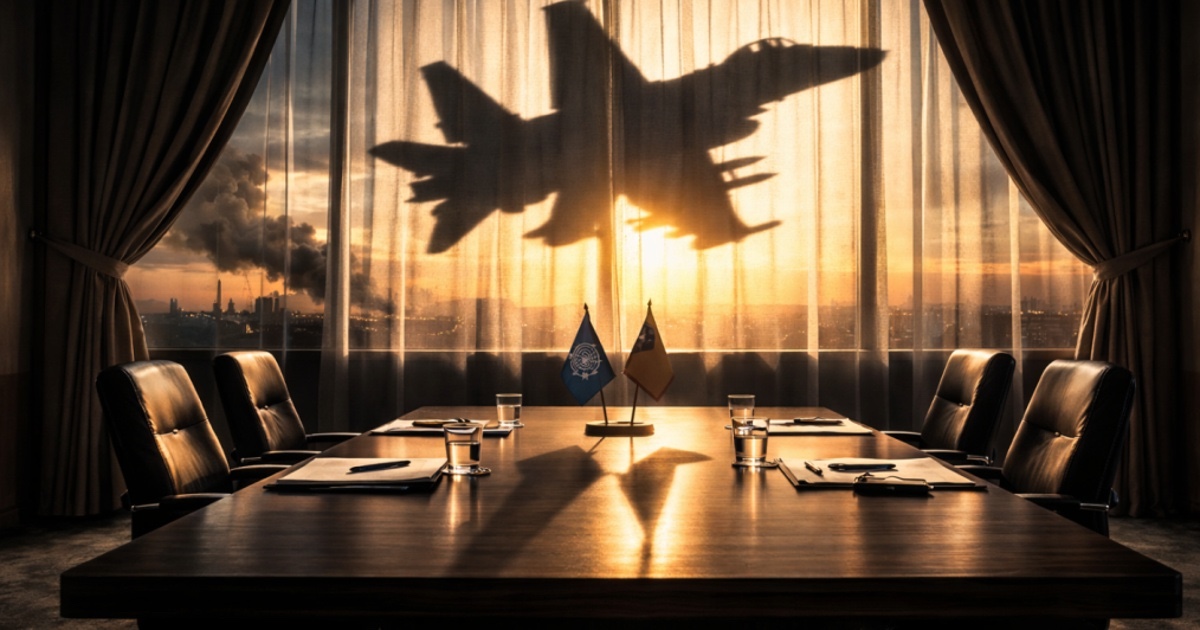
With the third round of indirect negotiations between Iran and the United States in Geneva ending without a final agreement and the continuation of talks referred to the technical level in Vienna, a fundamental question once again stands before the protest movement in Iran, the peoples of the region, and the global working class: will what is unfolding in negotiation rooms – and simultaneously on the military fields of the Middle East – lead to a large-scale war or to a temporary agreement? And in either case, which forces stand to benefit and which classes and peoples will bear the costs?
What is happening now cannot be understood merely through the appearance of diplomacy or by counting warships and aircraft. The situation represents a condensed expression of the historical policy of global capitalist powers: negotiations under the shadow of threat.
The simultaneity of negotiations and military escalation is neither a contradiction nor an exception. It is the expression of a single mechanism in which the negotiating table is the continuation of the field of force, and the field of force becomes an instrument for imposing the outcome of negotiations.
Within this logic, if an agreement emerges it will not represent a lasting peace but rather a managed ceasefire. And if war erupts, it will not be an unexpected accident but the continuation of the same crisis management through military means.
At the center of the policies of the powers involved in this reactionary confrontation two different yet parallel tendencies can be observed. Israel seeks to alter the regional balance of power and further weaken Iran in order to eliminate a competing center of power in the Middle East and consolidate its military and political dominance. In contrast, the United States—amid the global crisis of capitalism and the increasingly multipolar competition among powers—appears less interested in an uncontrolled collapse of the Iranian state than in negotiating a top-down arrangement to discipline the Islamic Republic.
The aim is to draw Iran into the orbit of the Western capitalist market, reduce its confrontational regional policies, and transform it into a more “manageable” state within the framework of Western strategic interests.
Although these strategies appear different, they converge on one point: weakening the Iranian state and limiting its regional capacity, whether through a temporary agreement or through limited strikes and proxy operations.
From an internationalist and class perspective the dividing line becomes clear. The ruling classes in Tehran, Washington and Tel Aviv share a common objective: preserving a social order based on exploitation and transferring the costs of crisis downward.
War or temporary agreements can both serve this goal in different ways: by intensifying economic pressure, expanding securitization, weakening working-class resistance and blocking independent organization.
For this reason, a large-scale war in the short term is not the most likely scenario, since its costs for the global capitalist order would be enormous and difficult to control. Yet the danger of limited strikes, proxy warfare and unintended escalation remains real.
The task of the international working-class movement is therefore not to watch the power struggles of states or to place hopes in any geopolitical bloc, but to expose the shared logic of capital and organize resistance from below.
Today, more than ever, anti-war and anti-capitalist centers must be built in connection with strikes and independent organizations. From the everyday struggle against poverty, repression and the denial of rights, the banner of opposition to war must be raised. Through internationalist solidarity it must be made clear that workers in Iran, the United States, Israel and across the region have no interest in war—they are its primary victims.
Real peace will not emerge from the negotiating tables of governments, but from the organized power of workers and the oppressed—from the same force capable of stopping the war machines of states and breaking the chains of exploitation.
Towards anti-war and anti-capitalist centers
Neither monarchy nor religious rule — power to workers’ councils
Neither fascism nor nationalism — long live internationalism
27 February 2026
Internationalist Workers’ Organization