
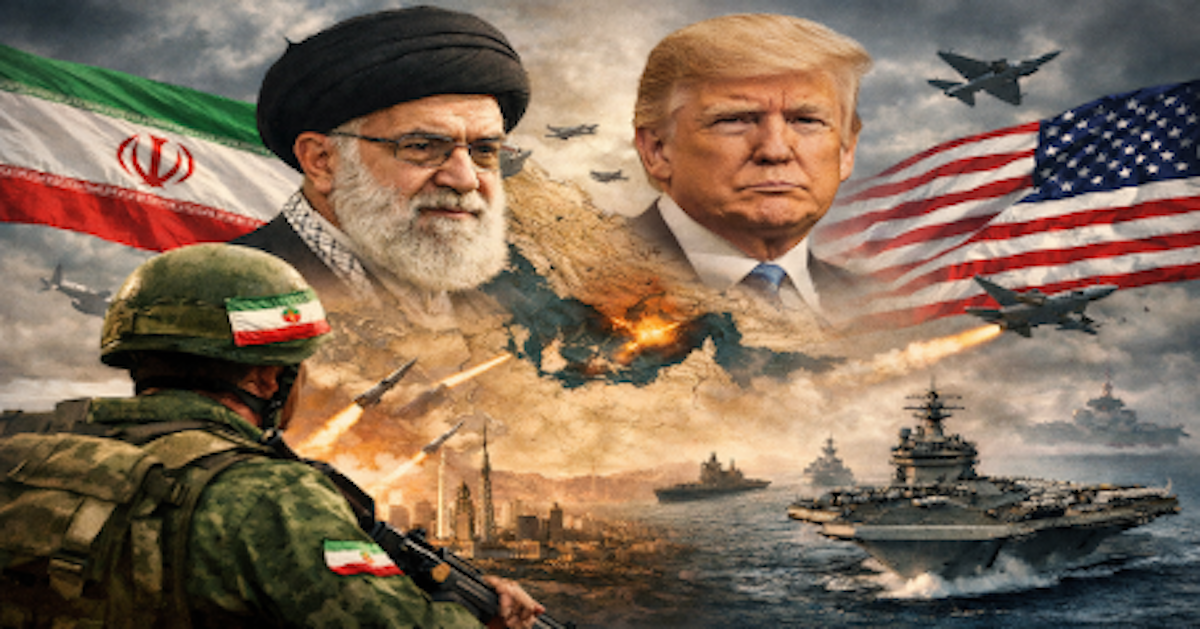
The recent developments surrounding tensions between the United States and Iran, along with continuous reports of troop movements, changes in military deployment, and the growing presence of U.S. carrier strike groups in the region, have dominated the headlines of official media. At the same time, another process is unfolding: popular protest uprisings are increasingly being transformed into instruments within the power struggles of global actors.
This raises a central question: will the current escalation between the Islamic Republic and the United States lead to a large-scale war, to a temporary agreement, or simply to the familiar cycle of pressure and negotiation that has repeatedly characterized modern history?
The answer cannot be found solely at the level of diplomacy or military maneuvering. What is unfolding today in the Middle East reflects a deeper crisis in the reproduction of global capital and the competition among imperialist powers over energy resources, trade routes, and geopolitical balance.
If we take the dominant analyses of ruling-class media and expert circles as a point of departure, their framework inadvertently reveals an important truth: what we are witnessing is “diplomacy under the shadow of military threat.” This is a classic mechanism of the capitalist world system. On the one hand, it shifts the costs of crisis onto the working classes and the popular masses of the region. On the other hand, through displays of military power and strategic deployment, it transforms the negotiating table into a field of coercion in order to extract maximum concessions without entering into a war whose consequences might spiral beyond control.
Debates within security circles about potential disruptions in oil flows, the closure of the Strait of Hormuz, or risks of escalation indicate that a major direct war is not the preferred option in the logic of global capital. Rather, it is something that can occur unintentionally if crisis management fails. What is generally preferred is either a limited agreement or a limited strike aimed at reshaping the balance of power and restoring order.
From an internationalist perspective, however, the analysis must shift from the level of states to the level of classes. The ruling classes—both in Washington and in Tehran—speak different political languages but share a common objective: preserving a social order based on exploitation while transferring the costs of crisis onto the lower classes.
In the United States, military deployment serves domestic politics, the military-industrial complex, and the maintenance of regional hegemony. In Iran, external tension functions as a mechanism for securitizing society and containing class struggle. Thus whatever outcome emerges—whether a temporary agreement or a limited military strike—will not, in its dominant form, improve the conditions of workers. Instead, it will represent a reconfiguration of the mechanisms of control and the reconstruction of the existing order.
The present moment must therefore be understood as a phase of bargaining under threat within the historical crisis of capitalist reproduction. Global capital seeks to escalate tensions to a level sufficient to secure concessions, but not so far that control is lost. The Islamic Republic seeks economic breathing space without dismantling its structures of deterrence. For this reason, a temporary agreement appears more likely in the short term than a large-scale war. Nevertheless, the risk of accidents or escalation through a limited strike remains significant.
The internationalist response to this situation cannot be to place hopes in any power bloc. It must instead expose their shared logic and defend the political independence of the working class. Only the conscious and independent organization of the working class can break the cycle of war, sanctions, and repression.
Towards anti-war and anti-capitalist centers
Against our “own” governments engaged in reactionary war
Freedom – Equality – Workers’ Councils
22 February 2026
Internationalist Workers’ Organization
