
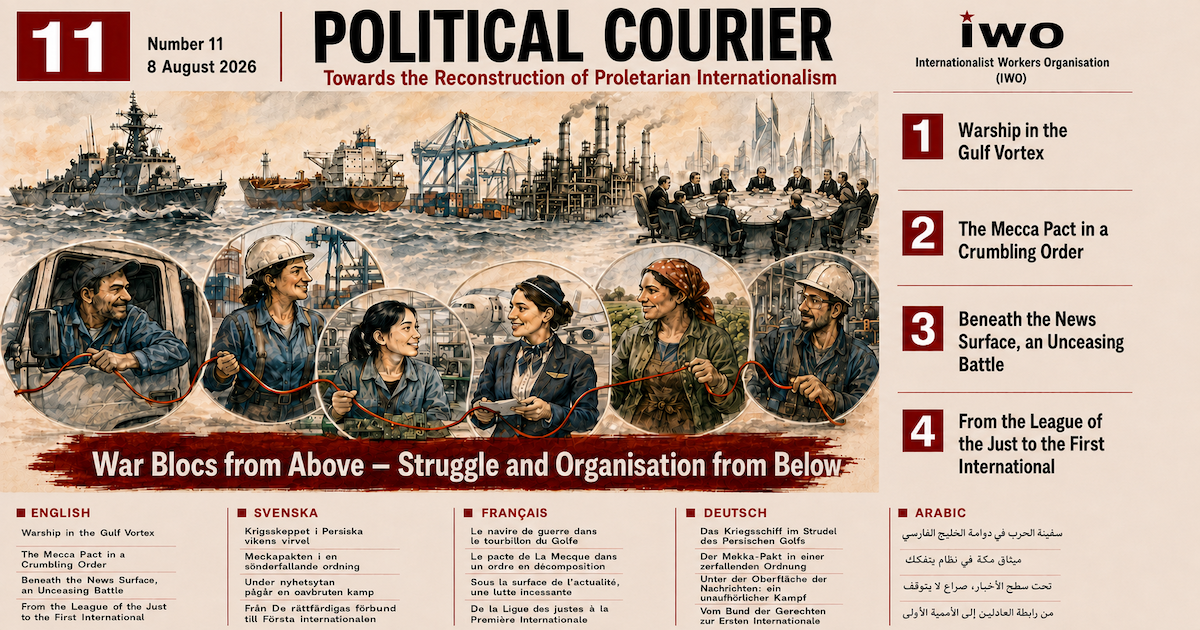
The Warship in the Persian Gulf Maelstrom
America’s Deadlock, the Bargain over Hormuz, and the Continuing War Against Life
The warship that entered the Persian Gulf promising the rapid surrender of the Islamic Republic can now find no way out. Five months of bombing, blockade and retaliatory attacks have failed to achieve the United States’ declared objectives. The Islamic Republic has neither been overthrown nor forced to surrender; its capacity to retaliate has not been completely destroyed; and Hormuz has not come under Washington’s control. The American war machine can still devastate, but it has been unable to turn its destructive power into political victory.

The sound of missiles has now briefly subsided, and negotiations over Hormuz have moved to the centre of the war. But this is not peace. The larger assault threatened by Trump has for the moment been postponed; ships continue to be targeted, the blockade of Iranian ports remains in place, and the oil, water and electricity installations of the Gulf states remain under threat of attack. What is taking place is an armed negotiation conducted under the shadow of a possible return to bombing.
Destructive Power, Inability to Win
The temporary reduction in American attacks is the product of its strategic failure. The war has depleted the missile and interceptor stocks of the United States and its allies; insecurity in Hormuz has driven up energy prices and inflationary pressure; and the continuation of the war in the run-up to the midterm elections has become a political liability for Trump. Arab governments, seeing their oil facilities and desalination plants exposed to attack, have also pressed for a new wave of bombing to be prevented. Washington has been forced to retreat from large-scale aerial destruction to an economic and naval blockade: a change in the conduct of the war, not its end.
The United States is no longer the unchallenged architect of the war’s outcome. Iran and Oman are negotiating the passage routes through Hormuz, while Washington waits outside the room for an agreement it did not write. The United States can still obstruct an agreement by maintaining the blockade or launching a new attack, but it can no longer determine the agreement’s form on its own. The conflict within Washington centres on precisely this deadlock: whether to continue a war of attrition or accept a role for the Islamic Republic in Hormuz that the United States was unwilling to recognise before the war.
This confusion has a material basis. A large proportion of the long-range precision missiles, Tomahawks, and Patriot and THAAD interceptors have been expended, while the military industries cannot replace them at the rate at which the war consumes them. Every new attack requires not only more missiles for the bombardment but also more interceptors to counter Iran’s response. Continuing the war also erodes American military capacity on other fronts of global rivalry.
Trump’s defenders claim that Iran is losing hundreds of millions of dollars each day and that its military and nuclear industries have been paralysed. But if the Islamic Republic has been “crushed”, why has the United States still been unable to reopen Hormuz and why is it now considering an agreement that would allow Tehran to control the strait’s inbound route? Why has the objective of “victory” been reduced to reopening Hormuz and containing oil and petrol prices before the elections? America’s strategic failure has become so obvious that even the paid mouthpieces of the media can no longer conceal it.
But this failure does not amount to a victory for the Islamic Republic. The blockade has brought Iran’s oil exports almost to a standstill and reduced tanker activity at Kharg Island to its lowest level. Closing Hormuz disrupts the circulation of oil and commodities, but it also blocks the regime’s own source of revenue. To increase its bargaining power, the Islamic Republic targets ships, expands the war in the Red Sea, and holds the lives of millions hostage by threatening the oil, electricity and water installations of neighbouring countries. Two states caught in the maelstrom of capital’s crisis are attempting to transfer the cost of their deadlock onto society.
Hormuz: Bargaining over the Circulation of Capital
What states call “freedom of navigation” or “sovereignty over the strait” is a conflict over control of the circulation of capital. The United States wants oil, gas and commodities to pass under the protection of its warships; the Islamic Republic turns control of vessels entering the strait—and the ability to prevent some of them from passing—into an instrument of power; while Arab governments and shipping companies seek the restoration of secure exports and their profits.
The Muscat plan, under which the inbound route would be assigned to Iran and the outbound route to Oman, would not resolve these contradictions. It is an attempt to reopen an artery of capital circulation without resolving the war’s deadlock. Its implementation could inaugurate a period of “armed peace”: the United States would not entirely abandon the blockade and its threats, while the Islamic Republic would use the resulting economic breathing space to restore its revenues and rebuild its machinery of repression. At the same time, a reduced danger of direct bombardment could create greater space for the return of protests and the independent organisation of workers and social movements.
America’s deadlock has also produced new alignments in the region. The Mecca military pact between Saudi Arabia, Turkey and Pakistan is not merely a response to the Iranian threat; it also indicates a loss of confidence in America’s ability to defend its allies and contain the war. Yet none of these states has entered the arena to save the population. The United States defends the freedom of capital; the Islamic Republic pursues its own survival under the cover of “national sovereignty”; and the other powers seek their share in the emerging order.
For the workers employed on oil tankers, in ports, refineries and power stations, Hormuz is not merely a line on a map. Every missile first kills or injures a seafarer. Every threat against a port or refinery makes the lives of thousands insecure. Rising oil prices become higher costs for fuel, food and transport, while every billion spent on missiles and interceptors is stolen from our housing, healthcare, education and lives.
In This War, No State Flag Is Ours
We workers must neither line up behind the warships of the United States and Israel nor allow ourselves to be mobilised under the flag of the Islamic Republic. America’s defeat is not our freedom, and the strengthening of the Islamic Republic’s position in Hormuz adds nothing to the power of the working class. The “defence of the homeland” and the “anti-imperialism” that call upon us to defend the regime sacrifice the interests of our class to the survival of the ruling bourgeoisie. Calls for greater American intervention, harsher sanctions and regime change imposed from above likewise hand society’s future over to the very powers that have created this devastation.
A temporary bargain may reopen Hormuz, but the return of oil tankers will not mean the end of the war against life. The “peace” of states may become an opportunity to rearm and prepare for the next round of war, just as the collapse of an agreement could push the region towards the wider destruction of refineries, power stations and water networks.
The American warship is trapped in the Persian Gulf maelstrom, but its retreat will not in itself open a road to liberation. That road must be built from below: through the resistance of oil and port workers, the solidarity of seafarers and transport workers, and the linking of workers’ struggles in Iran, across the region and in Western countries against war, blockade, repression and exploitation.
Our answer is not to choose between two war machines. It is the independent organisation of the class that sails the ships, extracts the oil, keeps the ports moving and pays the price of war. The force that keeps the world of capital running can also bring its war machine to a halt.
The Mecca Pact in a Crumbling Order
Sharing the Costs of War or the Emergence of a Military Bloc in the Middle East?
The Mecca Defence Pact between Saudi Arabia, Turkey and Pakistan was signed in the midst of a war that has exposed the inability of the Middle East’s security order to function. Under its central clause, an armed attack against any one of the three countries is to be regarded as an attack against all members—a commitment that Turkey’s foreign minister has compared, in technical terms, to Article 5 of the NATO Treaty. Yet the full text of the pact, the geographical scope of its commitments, its decision-making mechanism and the form of any joint command have still not been published. Describing it as an “Islamic NATO” therefore expresses the possibility of its future development more than it describes its present structure.

The significance of the Mecca Pact cannot be explained solely by the threat from Iran, concern over Israel or the three countries’ previous cooperation. Its emergence must be understood within a broader crisis: the crisis of an order that took shape under American dominance after the Cold War and is no longer capable of containing the world’s economic, political and military contradictions within its previous framework. The United States remains the world’s greatest military power, but a growing gap has emerged between its capacity for destruction and its ability to impose a stable political order.
The Erosion of the US-Led Order
American global leadership did not rest on military power alone. A network of military alliances, bases, financial institutions and allied states distributed the cost of maintaining this order while concentrating its command in Washington. NATO was the organised form of this structure in the West, while the American security umbrella in the Middle East constituted a less formal version of the same order. The Gulf states provided financial and energy resources and, in return, entrusted their security to American bases, weapons and guarantees.
This structure is now under pressure from two directions. The historical crisis in the reproduction of capital has intensified competition over energy, markets, technology and trade routes, while the cost of maintaining several military fronts—from Europe and the Middle East to East Asia—has simultaneously increased. The United States wants to retain command of the order while transferring a larger share of its costs to its allies.
The Trump administration’s insistence that NATO members increase their military spending must be understood within this framework. The demand that Europe pay a larger share is not merely an accounting dispute; it signals a change in the way American leadership is exercised. Washington wants its allies to assume greater financial and military responsibility without diminishing American strategic control over the alliance network.
But the transfer of costs does not necessarily stop at the point desired by the United States. States that develop military industries and joint defence structures gradually acquire the capacity to make independent decisions as well. The contradiction in American policy begins here: Washington wants to share the costs, but not the power.
The Iran War and the End of the Illusion of Immunity
The Iran war did not create this crisis, but it made it more visible. Missile and drone attacks on the bases and infrastructure of American allies demonstrated that the presence of US forces and the purchase of expensive defence systems do not guarantee their immunity. The American war machine possesses immense destructive power, but it has been unable to rapidly restore the security of its allies, freedom of navigation or stability in the energy market.
For the region’s governments, the conclusion was clear: complete dependence on the United States is no longer sufficient for confronting a prolonged, multi-front war. The Mecca Pact is a response to this experience, but that response does not necessarily signify a break with the United States. All three members remain connected, to varying degrees, to Western military, intelligence and economic structures, while Turkey is itself a member of NATO. At its present stage, the Mecca Pact therefore stands on the boundary between two possibilities: a regional sharing of the costs of the US-led order and the creation of the nucleus of a relatively independent bloc.
A Pact Against Which Enemy?
Reducing the Mecca Pact to an alliance against Iran prevents us from understanding its character. The three countries do not have identical motivations or perceptions of threat.
For Saudi Arabia, Iran’s missile capacity, the war in the Red Sea, and the vulnerability of oil facilities and desalination plants constitute direct threats. Riyadh needs a mechanism that reduces its exclusive dependence on the United States without eliminating its alliance with Washington.
Turkey’s calculations are more complex. Despite being a NATO member, it is seeking to become a centre of defence production and a relatively independent military power. Rivalry with Iran, growing tensions with Israel and distrust in NATO’s cohesion all figure in Ankara’s calculations. Neither the Iranian nor the Israeli threat can therefore be regarded, on its own, as the reason for Turkey’s decision to join the pact.
Pakistan also has a long history of military cooperation with Saudi Arabia, but its security policy remains shaped by rivalry with India, economic needs and its position as a nuclear power. Islamabad’s entry into the pact provides Saudi Arabia with military backing while offering Pakistan greater resources and regional influence.
The Mecca Pact is therefore not an alliance of three states against a common enemy; it is the point at which three different security calculations intersect. Those differences may eventually prevent it from becoming a fully integrated alliance.
From a Unipolar Order to Fluid Blocs
The Mecca Pact is one sign of a transition from a relatively centralised order to a fragmented one. But this transition has not yet produced coherent and stable blocs. What is emerging is a collection of fluid and overlapping alliances: Turkey simultaneously belongs to NATO and the Mecca Pact; Saudi Arabia is a strategic partner of the United States while expanding its relations with China and other powers; and Pakistan moves between cooperation with China, financial dependence on the Gulf states and military relations with the West.
This does not mean the immediate end of American dominance. Rather, it indicates the erosion of the US monopoly over the organisation of the global order. States in the region no longer want to entrust their security to a single power. They seek to participate in several networks simultaneously and use competition among the great powers to strengthen their own bargaining position.
The Mecca Pact may therefore both complement the American policy of sharing security costs and create the basis for its members to distance themselves from Washington. Its ultimate direction will depend on whether it remains confined to limited defence coordination or moves towards joint command, integrated arms industries, troop deployments and an expanded membership.
The Danger of Wars Becoming Connected
The fragmentation of the global order does not reduce the danger of war. On the contrary, the proliferation of decision-making centres and collective defence commitments may cause local crises to spread more rapidly. If an attack against one member of the pact is treated as an attack against all, a limited confrontation may draw more states into war.
The war in Ukraine is a separate front of the same global crisis, not the cause of the Mecca Pact’s emergence. Nevertheless, Ukraine’s recent attack on an Iranian ship demonstrated that the boundaries between separate wars have become permeable. Diplomacy has for the moment prevented an Iranian counterattack and a widening of the conflict, but the repetition of such incidents could connect the Iran war with the war in Ukraine. Iran’s military ties with Russia, Western support for Ukraine and Turkey’s membership in NATO are channels through which a limited confrontation could acquire much broader dimensions.
Security for States, Expanding Insecurity
The Mecca Pact is not yet a fully developed “Islamic NATO”, but the formation of a new military bloc outside NATO’s formal structure is a significant development. On the one hand, the pact is a product of declining confidence in the American security umbrella; on the other, it results from the policy of transferring part of the military costs to allied states. Its contradiction lies precisely here: a mechanism that may have emerged to share the burden of the existing order could, through its own development, become a centre for the redistribution of power and participation in the construction of another order.
The emergence of every new military pact directs more resources towards armaments, further militarises states and increases the danger that societies will be drawn into wars fought over power, energy, markets and the routes through which capital circulates. The multipolarisation of the capitalist world is not in itself an emancipatory alternative to American dominance. It may merely increase the number of powers and blocs competing with one another to divide the world.
The turn towards new military alignments and alliances is the response of states and ruling classes to the decline of the US-dominated order and the crisis in the political structure of global capitalism. Through the transfer of costs, renewed armament and the construction of new alliances, they seek to preserve or strengthen their position in the emerging order. But the same crisis that drives the bourgeoisie towards military organisation on a transnational scale also confronts the struggle of the working class with a global necessity.
The workers’ response cannot be to choose between rival blocs or to place themselves beneath the flag of one state or another. Independent workers’ organisation begins in the workplace and in specific local struggles, but it cannot remain confined to that level or within national borders. The task is to find the means and forms through which militant workers’ groups and circles in different countries can be connected, scattered experiences transformed into a common force, and resistance to war, militarism and the transfer of the crisis’s costs coordinated across borders. The class that sails the ships, keeps the ports and industries running, produces the weapons and pays the cost of all these alliances and wars is materially the only force capable of stopping the war machine and breaking the logic of capitalism’s military blocs.
Confronted with ruling classes that organise their crisis through transnational alliances, renewed armament and the distribution of costs, workers’ struggles must likewise find ways to connect and coordinate across borders. This necessity is not a subjective demand; it arises from struggles already taking place throughout the world.
Beneath the News Surface, an Unceasing Struggle Continues
News of Workers’ Struggles Around the World and the Reality the Media Conceal
What follows is not a complete list of workers’ protests and strikes around the world. It presents only twelve examples of struggles that expanded so widely during 2025 and 2026 that they could no longer be ignored. Trucks stopped moving, flights were cancelled, ports and factories ceased operating, and exports and supply chains faced disruption. It was at this point that workers’ protests managed to break through the media’s wall of silence.

The bourgeois press does not ordinarily consider the daily reality of exploitation to be news. Workforce reductions, increasing pressure, job insecurity, inadequate wages and the gradual formation of resistance usually remain invisible until they disrupt the circulation of capital. Even when a struggle becomes news, the headlines speak less about workers’ demands and organisation than about cancelled flights, corporate losses, rising prices and disruptions to services. The decline of the “labour page” and the decreasing number of specialised labour reporters have also been documented in media research. The Columbia Journalism Review has written about the disappearance of labour reporters from newsrooms, while other studies have shown that the commercial media generally represent the relationship between labour and capital from the standpoint of the consumer and market disruption, rather than from that of workers as agents of struggle.The Middle East: A Network That Began on the Road
In May 2025, a strike by truck drivers in Iran began in Bandar Abbas and spread across the country. Low wages and freight rates, rising insurance and spare-parts costs, unsafe roads and the prospect of higher fuel prices were among the causes of the movement. Images of stationary trucks and reports of disruption at ports and along transport routes made visible a strike whose coordination had largely taken place outside official structures through communication among the drivers themselves. Reports indicated that the strike had spread to more than 160 cities and that a number of drivers had been arrested.
In November of the same year, approximately 150 employees of Swatch shops and offices at sixteen workplaces in Turkey went on strike. The proposed wage increase was below the rate of inflation, and in addition to pay, the workers emphasised workplace rights, equal access to benefits and participation in disciplinary procedures. The strike ended after more than two weeks with an agreement that included wage increases and improved benefits. The media closed the story by announcing the “end of the strike”, but what remained was the shared experience of workers who had previously worked in separate shops and had now come to recognise themselves as a collective force.
Asia: From Component Factories to Artificial Intelligence Industries
In April 2026, factory workers in the industrial regions of Haryana and Noida in India stopped work and took to the streets in response to the rising cost of living, long working hours and the unfair payment of overtime. Their movement forced the Haryana government to raise the minimum wage by 35 per cent. A few days later, the protest in Noida entered its fourth day, and police used tear gas to disperse the workers. This movement emerged not from a single factory, but among contract workers and numerous workplaces across an industrial hub.
In South Korea, around forty thousand Samsung workers participated in the largest rally in the company’s history in April 2026. The dispute concerned the workers’ share of profits, the bonus system and job security in the face of the expansion of artificial intelligence and robotics. Under pressure from protests from below, the union—which now represents more than half of Samsung’s domestic workforce—was compelled to call an eighteen-day strike. The struggle in one of the world’s most advanced industries demonstrated that technology has not dissolved class antagonism; artificial intelligence and automation have themselves become subjects of conflict over employment, control of production and the distribution of profits.
Latin America: From Labour-Law Reform to Banana Plantations
In February 2026, a nationwide strike was held in Argentina as Congress debated the labour-law reform proposed by Javier Milei’s government. The reforms included restrictions on the right to strike, lower dismissal costs, weakened protections related to illness and the possibility of extending the working day to twelve hours. The strike disrupted transport and economic activity, but the Chamber of Deputies approved the bill. The end of the strike could not bring to an end the contradiction to which the law itself had given a new form: capital’s attempt to lengthen the working day, make dismissals easier and restrict the workers’ collective power.
In Panama, thousands of workers on Chiquita’s banana plantations went on strike in the spring of 2025 against social-security reform and the threat it posed to pension rights. In response, the company dismissed more than six thousand workers, and its management left the country. The government declared the strike “illegal” and suspended some legal guarantees in the province of Bocas del Toro. Media reports focused primarily on the company’s losses of 75 million dollars and the halt in production; behind these figures, however, stood a confrontation between agricultural workers, a transnational corporation and a state defending its property rights.
Europe: General Strikes and Scattered Work Stoppages
On 3 June 2026, Portugal’s second general strike in six months halted trains and the Lisbon Metro, cancelled hundreds of flights and closed schools and parts of the hospital system. Workers opposed reforms that would make dismissals and outsourcing easier, render contracts more precarious and increase working hours without additional pay. The two general strikes ultimately forced parliament to reject the government’s proposal. This example is a reminder that the mass strike has not disappeared and can still alter the political balance of forces.
In Spain, the Airbus workers’ strike began at the Getafe plant in July 2026 and spread to other sites. Pay increases below the rate of inflation, intensified attendance monitoring and restrictions on remote work were among the causes of the protest. In an effort to retain control and contain the widespread unrest, not all the unions entered the struggle at the same time. One union initiated the strike, while the company’s largest union confined itself to issuing a threat, announcing that it would launch an indefinite strike in September if negotiations failed. This case illustrates the pressure placed on official organisations and their inability to contain the protests. Airbus workers in Spain were not satisfied with bargaining from above and compelled the union to yield to the collective movement.
North America: Point-by-Point Expansion and Defiance of the State
In the United States, the Starbucks workers’ strike began at 65 stores in November and December 2025 and, within a month, spread to more than 180 stores in 130 cities. Around 3,800 workers stopped work to demand increased staffing, predictable schedules, better wages and their first collective agreement. This was not a simultaneous shutdown across the entire company, but a point-by-point expansion through a network of stores—a form suited to a capital that has dispersed its workforce across thousands of small workplaces.
In Canada, ten thousand Air Canada flight attendants went on strike in August 2025 and continued their action even after the labour relations board ordered them to return to work. One of the central issues was payment for the time flight attendants work on the ground, before departure and after landing, without receiving wages. Defiance of the return-to-work order forced the government and the company to re-enter negotiations with the workers. Here too, the “law” functioned not as a neutral arbiter, but as an instrument for returning labour power to the process of accumulation.
Australia and Oceania: Chokepoints in the Circulation of Capital
In August 2026, around 150 workers at BHP’s port facilities in Port Hedland, Australia, began a two-day strike. They first halted ship loading and then stopped work altogether. This was the first significant industrial action at the facility in more than two decades. The number of strikers was small compared with strikes involving millions, but they worked at a chokepoint through which around 80 million dollars’ worth of iron ore is exported every day. The power of workers does not derive solely from their numbers; their position within the organisation of production and the circulation of capital is also decisive.
In New Zealand, a two-day strike by Air New Zealand’s long-haul cabin crew in February 2026 forced the company to cancel 46 flights in advance. The dispute emerged after negotiations over wages and working conditions reached an impasse. Rather than shutting down the entire company, workers in a specific part of the fleet selected the point that would have the greatest impact on international flights.
What Official Statistics and Daily News Reports Fail to See
These twelve reports are only the tip of the iceberg. Even in the United States, where strikes are recorded relatively systematically, the Bureau of Labor Statistics registered only 30 “major work stoppages” in 2025 because it counts only actions involving at least one thousand workers for an entire shift. In the same year, Cornell University’s Labor Action Tracker recorded 303 work stoppages and noted that, because of the shortage of verifiable information, even this figure was probably an underestimate. Nearly half of these strikes lasted fewer than five days, while 36 per cent involved fewer than fifty workers. Approximately 19 per cent were organised by non-union workers.
The decline of the massive and prolonged strikes associated with the era of Fordist concentration cannot therefore be equated with the end of the class struggle. Capital has divided production among contractors, supply chains, dispersed branches, platforms and transport networks, and struggle has assumed forms corresponding to this arrangement: short stoppages, overtime bans, rotating strikes, gatherings during breaks, collective refusal of shifts, road blockades, digital coordination and the spread of protest from one workplace to another. The mass strike has not disappeared, but it is no longer the sole measure of the power of the class.
Negotiation Does Not End the Struggle
Although official media portray formal trade unions as instruments for organising and defending workers, their function is in practice to control and contain workers’ struggles and channel waves of protest towards bargaining within the framework of tripartite agreements with the state and employers. Even where they are compelled to intervene actively, they confine the struggle to the negotiating timetable and the limits imposed by the laws of capital. Union leaders often transfer the power formed in the workplace to the negotiating table, reach an agreement and declare the dispute over. But a contract does not abolish the contradiction between labour and capital. Wage increases are eroded by inflation; work intensity rises again; new technologies threaten jobs; and management attempts to reclaim concessions it was forced to grant. From this perspective, the end of every negotiation marks the beginning of a new period in which experience accumulates and preparations are made for the next battle.
Behind these scattered reports runs a single reality: the permanent struggle of the exploited against the exploiters. This struggle does not always begin with a strike. It first appears in scattered conversations, individual refusals and shared grievances; it then creates a common language, trust and collective awareness, gives rise to informal networks and circles and may ultimately develop into lasting organisation and political self-organisation. In cases where protests culminate in a strike or an open collective action, they have already passed through numerous twists and turns and compelled the trade-union bureaucracy to accept an official strike. News agencies record only the moment of explosion, while the force behind that explosion accumulates over a long and often invisible period.
Along this path, the working class relies only on its own power. Groups that turn Marxism into a proprietary doctrine, the programme into a trademark and affiliation with a tradition into a title deed of political ownership stand outside this process. Some deny the existence and historical potential of the class, while others use its name for political business and to preserve their own organisational shopfronts. Yet the crisis of capitalism, the expansion of global production chains and the simultaneous attack on wages, job security and the right to organise have confronted the workers’ movement itself with a global necessity.
The reconstruction of proletarian internationalism does not begin with a declaration of loyalty to a creed. Its starting point lies in these real struggles: linking Iranian drivers with transport workers in other countries; connecting workers at Samsung and Airbus and in Australian ports across global production chains; and transferring experience among workers in shops, platforms, hospitals and plantations. The task is not to discover a vanished class, but to recognise a class that struggles every day, experiments with new forms of unity and, within these scattered conflicts, cultivates the possibility of reconstructing its political and internationalist organisation.
From the League of the Just to the First International
At the beginning of the communist movement, the programme, theory and organisational principles were products of the development of class struggle and concentrated expressions of the experience and political organisation of the workers’ movement. In today’s world, however, this relationship has largely been reversed. Instead of serving as instruments for concentrating the class’s experience, knowledge and struggle, programmes and platforms have become the “brands” of organisations that neither emerged and developed from within the workers’ movement nor depend on it for their continued existence. Many of these organisations have no understanding of the internal mechanisms through which workers’ struggles organise themselves or of the transformations those mechanisms have undergone during the past century. Theory and programme have become marks of distinction in the political marketplace, while “principles and beliefs” have been turned into certificates of ownership by groups that consider the mere declaration of allegiance to Marxism or a particular political tradition sufficient to take possession of its legacy.

The roots of this reversal must be sought in the separation of the production and development of knowledge from the real movement and the political organisation of the class—a historical relationship that has remained buried and unrecognised beneath the accumulated debris of academic Marxism and the competition among sects in the political marketplace.
This series of articles seeks to reconstruct the history of this relationship and demonstrate how communist theory, programme and organisation emerged from the struggle, experience and developing organisation of the working class, and through what process they subsequently became separated from it. The historical part of this research will be published in issues of the Political Courier; its epistemological foundations will be developed in the Workers’ Knowledge Courier; and its political and critical conclusions—including a critique of the dominant forms of party-building and organisation—will be pursued in issues of the Internationalist Courier. The aim is to return programme and theory from their position as organisational trademarks to their real place: as living instruments of knowledge, the concentration of experience and the political organisation of the workers’ movement.
Science, Movement and Organisation in Communism’s Transition to a New Stage
Before communism became a scientific theory, it was a real movement within the working class. But the vitality of a movement does not mean that its organisational and theoretical forms will remain adequate to the development of the struggle forever. Secret societies, circles of artisan workers and networks of revolutionary émigrés created the first centres of communist assembly, education and organisation. Yet the expansion of large-scale industry and the emergence of the modern proletariat also exposed the limitations of those same forms.
The workshop and artisan system was declining, while capital was concentrating growing numbers of workers in factories and industrial cities. Under these conditions, the struggle could no longer continue to depend on heroes such as Babeuf or Weitling, on the will of a devoted minority or on a plan for a sudden insurrection. The question was no longer simply that of seizing power through the conspiracy of a secret society. A vast class was taking shape and had to raise its local experiences to the level of a political and internationalist struggle.
The Crisis of Craft-Based Organisations and the Limits of Conspiratorial Politics
The earlier societies consisted mainly of artisans, workshop apprentices and migrant workers. Secret methods of operation were unavoidable under conditions of repression, but this necessity gradually became intertwined with a particular form of conspiratorial politics: the belief that a determined minority could carry out the revolution on behalf of the masses and subsequently reconstruct society according to its own ideal.
Weitling was one of the most prominent representatives of a communism that had emerged from the lives of artisan workers. His historical importance lay in providing German workers with their own theory, literature and independent organisation. The development of the struggle, however, also revealed the limitations of his theory. Marx’s disagreement with Weitling was not a denial of the role of pioneering workers. It was a conflict over the transition from a communism based on moral inspiration, revolutionary personality and the will to insurrection to a communism that made the material conditions of struggle, the structure of capitalism and the real capacity of the working class into objects of knowledge.
Marx and Engels later demonstrated in the Communist Manifesto that large-scale industry not only increases the size of the proletariat but also brings dispersed workers together, connects local struggles and creates the basis for transforming economic struggle into political struggle. Railways and new means of communication also helped concentrate struggles that would previously have required decades to take shape (Marx and Engels, 1848).
This class could not receive its consciousness and organisation from a hero. Scientific knowledge had to be produced through the collective experience of struggle, while political organisation had to become the means through which that experience was concentrated, criticised and generalised.
The Communist League: A Break Within Continuity
First page or manuscript copy of the “Rules of the Communist League”, adopted on 8 December 1847
The transformation of the League of the Just into the Communist League at the two congresses of 1847 was not simply a change in the name of an association. It represented a break within a movement that had itself emerged from earlier organisations. Because of repression, the League was still compelled to operate secretly, but its adopted rules show that it was seeking to distance itself from conspiratorial politics and obedience to charismatic leaders.
Under the statutes adopted in December 1847, the League consisted of local communities, circles, leading circles, a Central Authority and a Congress. Officials were elected and could be recalled, while the Central Authority was accountable to the Congress. The Congress was the League’s highest legislative body, and delegates participated with specific mandates from their organisational units. The objective was no longer expressed in vague moral language: it was the overthrow of the bourgeoisie, the rule of the proletariat, the abolition of a society based on class antagonisms and the creation of a society without classes and private property (Communist League, 1847).

The League’s members still came predominantly from among German-speaking workers and revolutionary émigrés, but its networks operated in London, Paris, Brussels, Switzerland and parts of Germany. Its internationalism was therefore manifested not in a fully multinational composition but in its transcendence of national organisation and its connection of migrant workers across several countries. The replacement of the slogan “All Men Are Brothers” with “Workers of All Countries, Unite!” was a concentrated expression of this transition.
The Manifesto: The Scientific and Political Concentration of a Movement
The League’s Second Congress commissioned Marx and Engels to draft a theoretical and practical programme. The Manifesto of the Communist Party was therefore neither an academic treatise nor a declaration of belief by two isolated thinkers. It was the product of the organisational needs of a movement that required a coherent understanding of capitalist society, the historical position of the proletariat and its own political objectives.
.
The preface to the first edition announced that the text was to be published in English, French, German, Italian, Flemish and Danish. This plan was not fully realised at the time. Following the defeat of the revolutions of 1848, the Manifesto was also pushed to the margins for a period. Its global expansion occurred later, alongside the reconstruction of the workers’ movement. In his preface of 1890, Engels wrote that the history of the Manifesto largely reflected the history of the modern workers’ movement: wherever large-scale industry and the organisation of the working class developed, the need for the text also increased (Engels, 1890)
The importance of the Manifesto did not lie in giving workers a ready-made truth from outside. It concentrated the movement’s dispersed experience into a theoretical framework and a political programme. The history of society was understood as the history of class struggle; the emergence of the proletariat was connected to the development of capital itself; and the emancipation of the workers was recognised not as the result of society’s moral reform but as the product of their own organised activity. In this sense, the Manifesto expressed the emergence of the science of class struggle: a science whose object was not a static society but its contradictions, movement and potential for revolutionary transformation.

Revolutionary Organisation as an Institution for the Development of Knowledge
The connection between science and movement did not mean that a theory had been completed once and for all and that the organisation’s only task was to propagate it. A revolutionary organisation had to gather the experiences of struggle, critically examine defeats and victories, test its political hypotheses in practice and develop its programme in accordance with new knowledge. Marx’s conflict with official science was therefore inseparable from his organisational activity. The critique of philosophy, political economy and bourgeois historiography was simultaneously an effort to equip the workers’ movement with knowledge of the real conditions of its own emancipation.
Marx applied the same criterion within the League. During the dispute of September 1850, he criticised the tendency led by Willich and Schapper because it treated revolution not as the product of developing conditions and the class’s preparedness but as the result of revolutionary will. According to Marx, material analysis was replaced in this outlook by voluntarism, while the “real process of revolution” was replaced by revolutionary slogans (Marx, 1850). The critique of sectarianism was therefore not merely an organisational dispute; it was a defence of the connection between scientific knowledge, the real conditions of struggle and the organisation of the working class.
This approach also challenged the official social sciences and humanities. Bourgeois science examined society from the standpoint of preserving the existing order. The science of class struggle studied those same relations from the position of a class compelled to transform the entire order in order to emancipate itself. From this point onwards, the theoretical struggle against official science became part of the proletariat’s political struggle.
The First International: Science and Organisation on a Global Scale
The dissolution of the Communist League in 1852 did not bring this process to an end. The growth of trade unions, cooperatives, strikes and political struggles in different countries created the need for a broader form of coordination. The establishment of the International Working Men’s Association in 1864 was a response to this new stage.
The First International was not a new sect with a predetermined doctrine. English trade unions, communists, Proudhonists, socialists and other tendencies within the movement all participated in it. Its statutes declared the Association’s objective to be the creation of “a centre of communication and cooperation” among workers’ organisations in different countries. Marx likewise drafted a programme whose point of departure was the movement’s actual level of development, without abandoning the objective of the working class’s complete emancipation.
In the Inaugural Address, Marx placed the experience of the struggle for the ten-hour working day and workers’ cooperatives in opposition to bourgeois political economy. He wrote that the numerical strength of the workers becomes a force only when it is united through organisation and guided by knowledge. The International was intended to organise precisely this unity on a global scale: exchanging experiences, coordinating struggles, combating cross-border strikebreaking and developing an independent politics of the working class.

Membership card of the International Working Men’s Association London, 1864
From the League of the Just to the Communist League, and from the Manifesto to the First International, a line of historical development can be traced: the movement creates its own science; science raises the movement’s experience from a dispersed level to general knowledge; and organisation becomes the site in which this knowledge and struggle are concentrated and sustained. Marx and Engels did not stand outside the workers’ movement. At a particular stage in its development, they became its leaders and organisers. The historical power of communism lay not in theory, movement or organisation taken separately, but in the living and continuous unity of all three.
References
Communist League (1847), Rules of the Communist League.
Engels, F. (1885), On the History of the Communist League.
Engels, F. (1890), Preface to the German Edition of the Communist Manifesto.
Marx, K. (1850), Meeting of the Central Authority, 15 September 1850.
Marx, K. (1864), Inaugural Address of the International Working Men’s Association.
Marx, K. and Engels, F. (1848), Manifesto of the Communist Party.

