
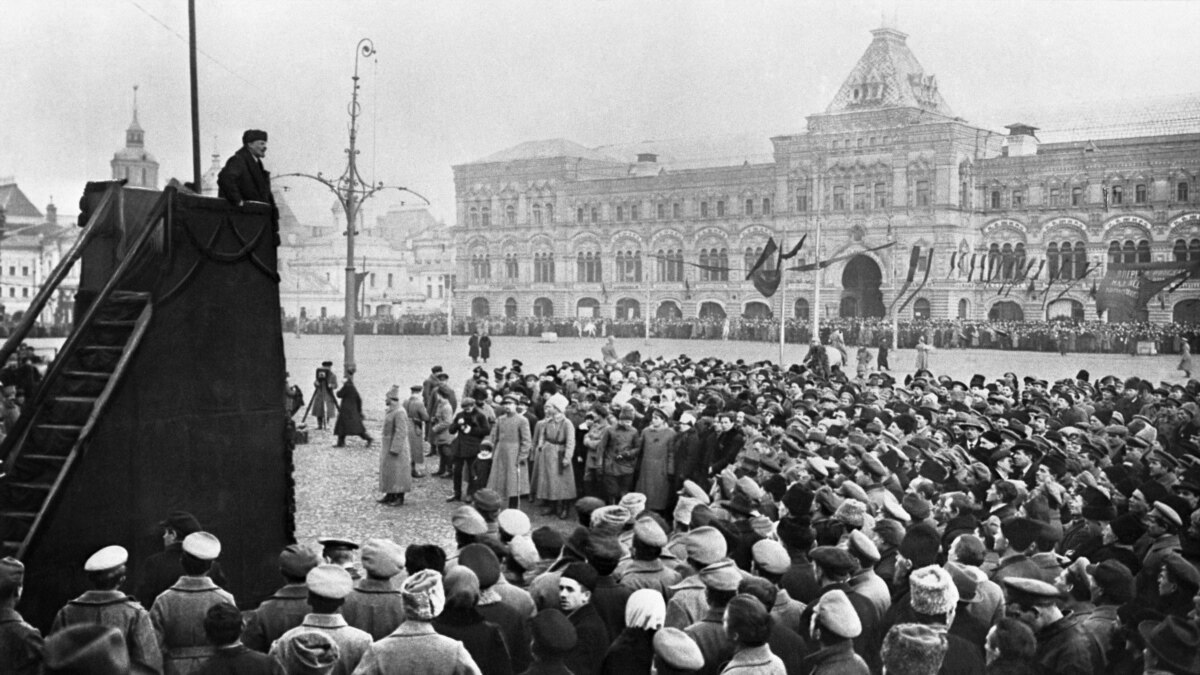
November 7 (16 Aban) marks the anniversary of the October Revolution—an reovolution that constituted the greatest historical and intellectual turning point of modern human society. During the First World War, at a time when the Russian Empire was in a state of extreme weakness, the Russian working class was able to play a decisive role in the class struggle of that country. When, in the February Revolution of 1917, the bourgeois character of the ruling factions and of the Social Democratic minister Alexander Kerensky became evident to the protesting workers and masses, the working class was able, through its party—the Bolshevik Party—to take the leadership of the revolutionary movement. The Bolsheviks, under the leadership of Vladimir Lenin, demonstrated through the second revolution the power of the working class and communism to transform society.
The October Revolution brought about the most advanced system of social welfare and social insurance of its time, the most appropriate political structure for workers’ participation in economic and political decision-making, and one of the most progressive movements for the liberation of women and youth. Its achievements were so immense that they were hardly conceivable even in the most advanced capitalist societies. The revolution led to the formation of the Communist International, aimed at organizing and leading the world revolution—an expression of the internationalist class character of the revolution itself.
Contrary to the historiography of the bourgeoisie and its left wings, the October Revolution was not a national revolution confined within Russian borders. It marked the beginning of a wave of world revolution whose flames spread across large parts of the globe, particularly Europe. Following the victory in Russia, revolutionary uprisings spread to Germany. In several regions, workers and their councils clashed directly with the forces of the bourgeois state. German Social Democracy entered into a bloody confrontation with the revolutionary wave and played a decisive role in its defeat. Due to the lack of preparedness and internal divisions among the German communists, areas that had briefly fallen under workers’ control were rapidly lost.
In the aftermath, armed formations linked to Social Democracy were able to assassinate leading figures of the communist movement such as Rosa Luxemburg. Social Democracy also exploited the demoralization of thousands of workers who had played a leading role in the uprising, forcing workers’ councils into compromise and surrender. In other European countries, particularly Italy, revolutionary movements also failed due to the unpreparedness of communist parties. Thus, with the defeat of the revolution in Germany and Europe, the перспективы of the October Revolution were thrown into uncertainty.
From the very beginning, capitalist states organized a broad offensive against communism and the working class. The revolution was subjected to unprecedented military, political, and ideological attacks. Armies from more than fifteen capitalist countries intervened militarily against Soviet Russia. Facing war, famine, and economic blockade, the young workers’ state depended on the extension of the revolution to Europe. With the defeat of the revolutionary wave in Germany, the isolation of Soviet Russia deepened.
Under these conditions, the Bolshevik Party was forced to halt the transfer of power to workers’ councils and undertake a temporary retreat. Emergency conditions led to the concentration of power in the party and the prohibition of factions. Political freedoms, which were meant to develop toward the economic emancipation of producers and their control over production, were drastically restricted. In the economic sphere, the New Economic Policy (NEP) was introduced as a temporary compromise to prevent collapse, followed by the imposition of one-man management in industry. These measures, however, became permanent features with the defeat of the world revolution and the rise of Stalinism.
The defeat of the October Revolution was neither sudden nor invisible. The class positions of the proletariat were dismantled step by step through a bloody struggle. The Workers’ Opposition and later the Left Opposition resisted this degeneration. Left communists in Russia and internationally—including Avetis Sultan-Zade—defended proletarian positions, but were systematically repressed.
Despite all defeats, the historical continuity of the communist movement persisted. The tradition of internationalist communists—defended above all by the Italian Communist Left after the Second World War—remains rooted in the lessons of the October Revolution.
The October Revolution, following the Paris Commune, was the first great experience of the world communist movement. It demonstrated that a collection of national parties is insufficient to confront global capitalism, and that the proletarian revolution requires a unified world party with a clear strategy.
The future socialist revolution, drawing on the lessons of past defeats, will open the path toward a human world society free from wage labor, poverty, ignorance, and war. The legacy of the October Revolution will forever remain a luminous peak in human history.
Long live the world proletarian revolution — Long live communism
Internationalist Workers’ Organization
October 16, 2004