
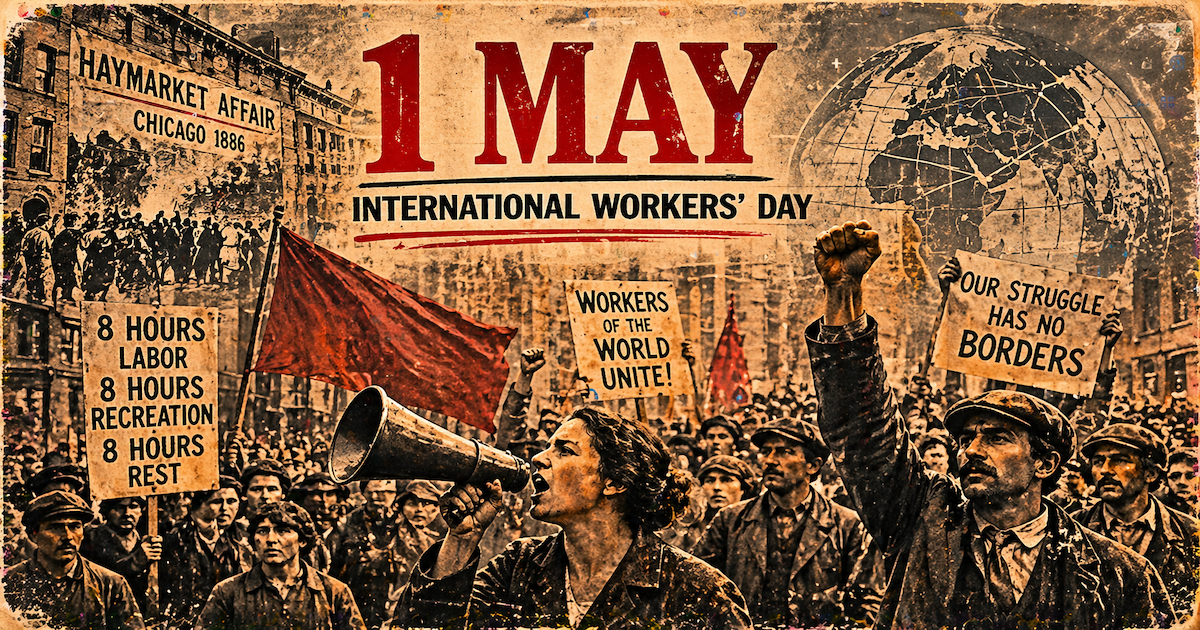
Issue No. 2 of Political Courier, the political bulletin of the Internationalist Workers’ Organization, is published on May Day 2026, at a moment when the global capitalist crisis manifests simultaneously through war, economic instability, and the intensification of authoritarian rule. This issue focuses on three central axes: a historical re-examination of May Day, the question of political platform and intervention, and an analysis of the current war situation, aiming to clarify the relationship between theory, class struggle, and present material conditions.
The first article, “From Haymarket to Today: The Historical Transformation and Political Appropriation of May Day,” traces the trajectory of May Day from its revolutionary origins in workers’ struggles to its various forms of appropriation and neutralization by states, parties, and official institutions. It argues that May Day has been progressively reduced to a symbolic or state-managed ritual, while emphasizing the necessity of reclaiming it as a tool of internationalist working-class struggle.
The second article, “Platform and Political Intervention: The Role of Publications in the New Phase of Theoretical–Political Activity,” addresses the question of political organization under current conditions. Here, the publication is understood not merely as a means of communication, but as a concrete form of political intervention and collective consciousness formation. The article explores how developing a political platform and sustaining regular publications can help bridge theory and praxis and contribute to the emergence of an internationalist perspective within the working-class movement.
The third article, “The Strait of Hormuz and the Deadlock of War and Crisis,” provides a condensed analysis of recent developments in the war involving the United States, Israel, and Iran, situating it within the structural impasses of global capitalism. It argues that this conflict is not merely regional but part of intensifying imperialist rivalries and the global displacement of crisis, and it emphasizes the necessity for the working class to adopt an independent, internationalist position against all sides involved.