
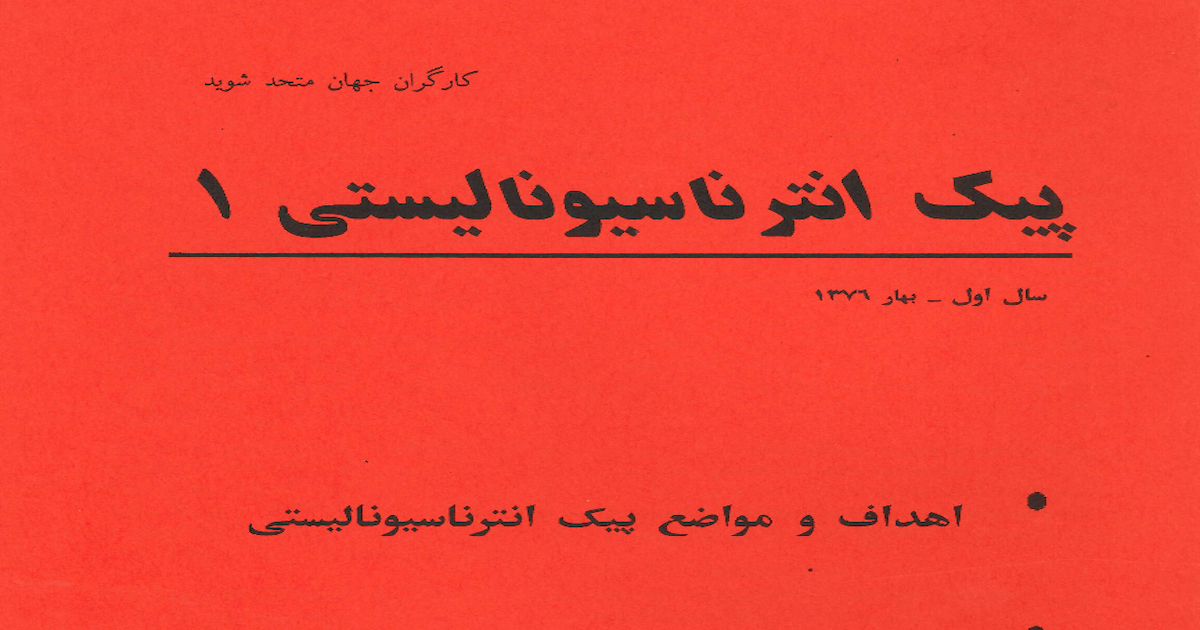
The activists of Internationalist Courier (Peyke Anternasionalisti) after four years of activity around this publication, hereby announce the formation of the Internationalist Workers’ Organization. The Internationalist Workers’ Organization situates itself within a specific historical tradition of the workers’ movement—a tradition that began with the secret workers’ societies and the Communist League led by Karl Marx and Friedrich Engels, and which continued through the International Workingmen’s Association, the left wing of the Second International, and the left wing of the Third International. This is a tradition that has upheld a proud banner, free from the distortions of false and bourgeois forms of communism—the tradition of the Communist Left, the tradition of internationalist communists.
The trajectory of the activists of Internationalist Courier is not limited to the four-year existence of this publication. The background of those involved in this movement goes back to a workers’ group, then to the Peykar Organization for the Liberation of the Working Class, to independent workers’ circles in Iran, and finally to the Association of Refugee and Immigrant Workers abroad. Efforts to organize workers’ circles in Iran, persistent attempts to arrive at communist positions, the organization of political refugee protests in Turkey in 1991, and attempts to organize workers’ circles abroad have constituted important aspects of our activity over the past two decades.
The crisis and collapse of the Peykar Organization marked the starting point of our efforts to analyse its causes and to sum up the debates of the so-called “Line 3” tendencies. This work continued over a decade of activity within workers’ circles, despite repression and the harsh pressures of working conditions. The initial foundations of our present positions—such as state capitalism, the rejection of the communist character of the so-called socialist blocs and of the Iranian left organisations, and the necessity of the political organisation of the working class—have their roots in that period. This process continued abroad. Activity within the Association of Refugee and Immigrant Workers was our final attempt to organise workers politically within the framework of past traditions. Our conclusions were presented in the article “Balance Sheet and Future”, published in Exiled Worker. This text represented the end of a path that had reached a dead end—a picture of the inability of a layer of workers’ activists to break with leftist traditions and trade unionism, and of their position at the “crossroads between social democracy and socialism” on the eve of the decline of the left. Subsequent developments confirmed this assessment.
At the same time, a twenty-year process of gradual development had led toward the tradition of the Communist Left. The launch of Internationalist Courier represented a qualitative step forward from “Balance Sheet and Future”. It was a step taken by a number of workers’ activists to revive the internationalist tradition within the workers’ movement in Iran. However, our attempts to converge with groups active within this tradition encountered obstacles—obstacles that also revealed weaknesses on our side. The historical defeat of the international communist movement has imposed a period of isolation on internationalist forces—an isolation that, due to its persistence, has even found a certain justification among these forces. Under such conditions, we considered it necessary, alongside publishing Internationalist Courier on the basis of the positions we had reached, to continue discussions with internationalist groups and independent circles. The first lesson of past experience was to avoid the irresponsible and nationalist organisation-building that has characterised the Iranian left.
The publication of Internationalist Courier must therefore be understood as part of a broader process of development. On the one hand, it expressed the qualitative development of independent workers’ circles—circles shaped by the defeat of the Iranian left and the failure of localist workerism. Circles that, while striving to reach class positions theoretically, remained confined within organisational and experiential limits in relation to the left. On the other hand, it emerged from a process of initially unsuccessful discussions with certain internationalist groups. Its emergence must therefore be understood as the intersection of a definite tendency within independent workers’ circles and the inability of internationalist groups to respond to their historical tasks.
The study of the history and positions of groups within the internationalist movement, along with discussions with some of them, has been one aspect of the activity of Internationalist Courier. Another aspect has been the effort to introduce this tradition through translations and through collective work and ongoing discussions among activists and collaborators. Based on these experiences, we have placed on our agenda the formation of a communist organisation, the publication of the political news organ Class Struggle, and the continuation of Internationalist Courier as a theoretical journal. The objectives of this stage are: the organisation of workers’ communist circles, the theoretical clarification of our positions, the critique of the ideological foundations of the Iranian left, and polemics with internationalist groups in the process of forming the world party of the working class.
The formation of the Internationalist Workers’ Organization represents the emergence of a political tendency that has taken a step forward in its process of organisation. We hope that this development will not remain limited to our movement, and that other groups who identify with the tradition of the Communist Left—despite differences with us—will also take steps in this direction.
Thus, with the continued publication of Internationalist Courier, the Internationalist Workers’ Organization is formed on May 1, 2001.
Fundamental Positions of the Internationalist Workers’ Organization
- The capitalist system, whose ascendant phase lasted until the end of the nineteenth century, entered its period of decline with the outbreak of the First World War. This transition was accompanied by changes in the functioning of the system, in the forms assumed by its crises, and in the structure of its superstructure.
- The integration of the economic and state apparatuses, as an expression of this period of decline and as a means for the system to escape crisis, began after the First World War. This process reached its height with fascism in Italy, the New Deal in the United States, the Popular Front’s economic programme in France, the welfare-state model in Britain, and finally the rise of Nazism in Germany and Stalinism in Russia. After the Second World War, this tendency toward the statification of capital intensified both in the metropolitan centres and in the periphery.
- The First and Second World Wars constituted capitalism’s only way out of its earlier crises during the period of decline. The continuation of the crisis since the 1970s has led to the intensification of conflicts between imperialist factions over access to new markets in the form of national and regional wars, to the collapse of the state-capitalist model, to the reduction of the role of the state in the economy, and finally to a broad offensive against the living standards of the working class. Under present conditions, the future of human society depends on the movement of the working class as the only transformative force of our age, and on its level of organisational preparedness on a world scale.
- Trade unions, which in the early phase of capitalist development were organs of class struggle, have in the present period become organs through which the ruling class and its factions control and derail workers’ struggles. In the present epoch, the possibility of reclaiming these organisations for the working class, or reforming them into independent workers’ organisations, has disappeared. Today, depending on circumstances and alongside workers’ struggles themselves, delegates’ committees, factory committees, and ultimately workers’ councils constitute the most appropriate forms of working-class organisation. The members of these organs are elected, recallable, and their functions are determined by workers’ assemblies.
- Participation in parliamentary and electoral spectacles in the period of capitalist decline and decomposition, under slogans such as “using the bourgeois tribune” or “revolutionarily destroying parliament from within”, ultimately serves only to strengthen parliamentary illusions and deepen the disorientation of the working class.
- All national movements constitute arenas of conflict between rival imperialist factions, and support for, or participation in, national conflicts means participation in reactionary wars.
- The many social oppressions of the present system, such as gender oppression and racial oppression, are integral to its very existence and are constantly reproduced by it. The formation of separate associations or organisations which do not target the real basis of these oppressions, namely the capitalist system, not only fails to contribute to their abolition, but also weakens class struggle by dividing the working class into fragmented gendered and racialised groupings.
- The October Revolution in Russia suffered a definitive defeat with the defeat of the German Revolution, the isolation of soviet power, and the consequent degeneration of the Bolshevik Party through the domination of Stalinism and the suppression of the left and workers’ oppositions. Following the degeneration of the Bolshevik Party and the Communist International, all left and communist parties were drawn into the process of integrating the state and economic structures and were transformed into the left wing of the capitalist political order. Contrary to the anti-communist propaganda of Western imperialism, the collapse of the former Soviet Union was not the defeat of communism, but the defeat of a particular model of capitalism under the impact of the deepening crisis of that system.
- All so-called socialist states to date, such as China, North Korea and Cuba, which emerged through mass national movements, have been and remain expressions of the crisis of capitalism and institutions of the left wing of the ruling class.
- All conservative, liberal and social-democratic parties defend the interests of different factions of world capitalism, while all Stalinist, Maoist and Trotskyist parties defend the interests of the left wing of the bourgeois class.
- The party of the working class does not substitute itself for the class in the class struggle. Its task is not to seize political power on behalf of the working class, but to intervene actively in the class struggle, to contribute to the elevation of the working class into the ruling class through the organisation of proletarian revolution, and to defend the communist programme for the establishment of a new human society.
26 April 2001