
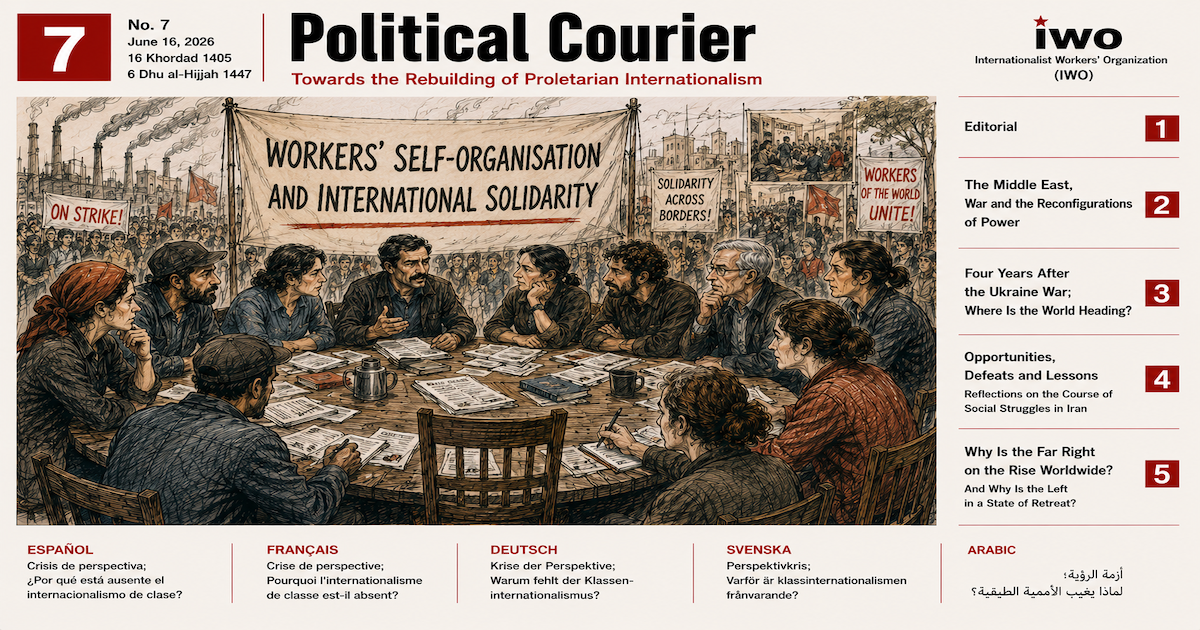
Today’s Wars, Tomorrow’s Questions
The world today moves forward amid a growing accumulation of crises, wars and instability. The war in Ukraine has entered its fifth year. The Middle East is once again engulfed in war, regional rivalries and the interventions of global powers. The world economy is lurching from one crisis to another. Institutions that were once supposed to guarantee stability and order—from the United Nations and the Security Council to the European Union and many national states—are increasingly confronted with crises of legitimacy and effectiveness. From Washington to Brussels, from Moscow to Beijing, and from Tehran to Tel Aviv, clear signs of the erosion of the existing order are becoming visible.

Yet if we look only at the surface of these developments, there is a danger that we will view them as a collection of separate and unrelated crises. As if the war in Ukraine, the crisis in the Middle East, the rise of nationalism, the spread of authoritarianism, the crisis of states and economic instability each had their own distinct causes. What stands before us today, however, is not simply an accidental accumulation of crises, but the expression of a deeper crisis in the reproduction of the existing order.
From this perspective, a historical crisis in the total reproduction of capital emerges when the difficulties of capital accumulation extend beyond the economic sphere and increasingly undermine the reproduction of the social, political, ideological, scientific and international conditions necessary for the continuation of capitalist rule. In such circumstances, the crisis no longer appears only in factories, financial markets or economic cycles. It manifests itself in states, international institutions, wars, social relations, forms of political organisation and even in the ways social consciousness is produced and reproduced.
For this reason, the crises of our time cannot be explained simply by economic downturns, governmental failures or rivalries among great powers. The war in Ukraine is not merely a military conflict between Russia and Ukraine. Developments in the Middle East are not simply a competition among regional states. The crisis of the European Union is not merely the result of disagreements among its member governments. What connects these phenomena is the gradual erosion of the mechanisms that have enabled the reproduction of the global capitalist order over recent decades.
Yet crisis in itself does not generate its own solution. The history of capitalism is filled with examples in which deepening crises have not led to the advance of emancipatory forces, but rather to the growth of nationalism, militarism, fundamentalism, populism and various forms of authoritarian rule. The financial crisis of 2008, the Arab Spring, the wars in Iraq and Syria, and many other developments of the last two decades demonstrate that fractures within the existing order do not automatically give rise to an independent and emancipatory perspective.
It is precisely here that the central problem of our time resides. The world is not suffering from a shortage of crises; on the contrary, crises have become more visible than ever. What is absent is not crisis, but a perspective capable of opening a path toward the future from within these crises. On the one hand, the old order is eroding and many of its political, economic and ideological forms are losing their former strength. On the other hand, new forces and alternatives have not yet succeeded in establishing themselves as a durable and universal horizon. This gap between the erosion of the old order and the inability of new horizons to emerge is one of the defining features of our age.
If today’s crises were merely a series of passing events, our task might simply be to interpret them. But when war, economic crisis, the erosion of political institutions, the spread of authoritarianism, the destruction of living conditions and social dislocation become different expressions of a single historical crisis, the question is no longer simply how to explain the world. The question is which social forces will enter the stage through this crisis, and what perspective for the future will take shape.
For this reason, Political Courier does not see itself merely as a medium for reporting events or as another voice within the marketplace of media and ideological production. Together with the Internationalist Workers Organization, this publication forms part of a broader effort to rebuild independent working-class politics and workers’ internationalism. It is an effort grounded in the conviction that without conscious organisation, without the reconstruction of the historical memory of the workers’ movement, and without the development of an outlook independent of all rival blocs of capital, the present crises may once again lead to new forms of war, exploitation and domination.
The decisive question for us is therefore not which state, military alliance or global power will gain the upper hand. The crucial question is whether the working class and the social forces bearing the main burden of these crises will be able to enter the field as an independent force and develop their own political perspective. The importance of this question lies not only in the outcome of today’s wars, but in the answers to tomorrow’s questions.
Political Courier No. 7 is a contribution to that effort. The articles in this issue approach the crisis of the global order, the war in Ukraine, developments in the Middle East, experiences of social struggle in Iran and the question of an independent working-class perspective from different angles. Their aim is not to offer ready-made formulas or predictions of the future, but to participate in a collective effort to understand the conditions in which we live and the horizons for which we must struggle.
Today’s wars will sooner or later come to an end. The questions they raise about the future of the world, the crisis of the existing order and the possibility of an independent working-class alternative, however, will remain.
The Middle East, War and Perspectives
At a time when indirect negotiations between the United States and Iran continue, ceasefires in Lebanon repeatedly face the risk of collapse, and the war in Gaza remains unresolved, the Middle East continues to exist in a state suspended between war and diplomacy. Several months after the attacks carried out by the United States and Israel against Iran, and after a chain of confrontations stretching from the Persian Gulf to Lebanon and Gaza, none of the principal actors in the region have achieved their declared objectives, nor has any new order emerged. .

Iran speaks of its regional influence and alliances, Israel insists on maintaining military pressure, the United States seeks to contain the costs of the crisis, and the Arab states are above all concerned with preventing further instability. This reality itself suggests that the central issue in the Middle East today is not the victory of one bloc over another, but the erosion of the order that dominated the region after the Cold War.
The wars of recent years have above all exposed the limitations of every major actor in the region. Despite maintaining significant regional influence, Iran has been unable to transform its position into a stable hegemony. The Islamic Republic’s network of regional allies continues to play an important role in the political and military balance of the Middle East, yet the conflicts of recent years have demonstrated the limits of this influence as well. Tehran has been able to withstand enormous pressure, but it has not been able to offer a solution to the region’s chronic crisis.
On the other side stands Israel. Despite its military superiority and the support it receives from the Western powers, the Israeli state has been unable to achieve lasting security through war. Large-scale military operations, security campaigns and escalating pressure on the Palestinians have neither resolved the Palestinian question nor brought an end to the region’s recurring security crises. On the contrary, successive wars have increasingly demonstrated that military superiority alone cannot resolve the region’s political and social contradictions.
The United States faces similar limitations. The project pursued after the collapse of the Soviet Union, aimed at establishing a stable order under American leadership in the Middle East, now confronts multiple dead ends. From Iraq and Afghanistan to Syria and Palestine, the experience of the past two decades has shown that Washington can no longer easily impose its preferred order upon the region. The United States remains the most important external power operating in the Middle East, but its power no longer translates into an ability to resolve the region’s crises.
The Arab states face contradictions of their own. Many are concerned about Iranian influence, yet at the same time fear the expansion of war. They depend on security cooperation with the United States while simultaneously deepening economic relations with China and, in many cases, maintaining channels of communication with their regional rivals. This demonstrates that even Washington’s closest allies are less interested in confrontation than in containing instability.
For this reason, the common image of two coherent and stable blocs competing for domination of the region is both incomplete and misleading. The region certainly experiences real polarisation and rivalry, but none of the principal actors possesses the capacity to impose its preferred order on the others. The American project has not achieved the stability it sought. Israel has not secured lasting security. The Islamic Republic has not established regional hegemony. Nor have the Arab states succeeded in creating an independent and stable regional order.
The result is not the emergence of a new order but the spread of a condition of chronic instability, a situation in which limited wars, proxy conflicts, political crises and regional rivalries become part of the permanent reality of the Middle East. Each new crisis tends not to resolve previous contradictions but to add new layers of instability.
This situation also demonstrates that the Middle East cannot be understood solely through the prism of interstate competition. Wars, sanctions and economic crises directly affect the lives of millions. Rising military expenditures, the destruction of infrastructure, growing poverty, displacement and political repression are among the permanent consequences of this condition. Beneath the surface of regional and global power rivalries another reality is unfolding: the reality of social discontent, popular protests and struggles that continue to emerge in different forms across the region.
The experience of the past two decades has shown that war and crisis do not in themselves open a path toward social emancipation. Just as none of the region’s major powers has been able to provide a solution to the accumulated crises of the Middle East, the deepening of crisis alone does not create a different future. Yet the spread of social protests, workers’ strikes and various forms of popular resistance demonstrates that the region is not merely a battlefield of states but also an arena of profound social conflicts that may play a decisive role in the future.
In conclusion, the future of the Middle East can be understood neither through expectations of the imminent collapse of the existing order nor through assumptions about the emergence of a stable new one. What stands before us today is a period of chronic instability, recurring wars and competition among powers none of which is capable of imposing its own solution. The central issue is therefore not choosing between one power bloc and another, but linking the struggle against war, militarism, poverty and repression with the social struggles unfolding throughout the region. Only within such a framework can one speak of a different perspective for the future of the Middle East.
Four Years After the Ukraine War: Where Is the World Heading?
At a time when Volodymyr Zelensky, in an open letter, has called on Vladimir Putin to engage in direct negotiations to bring the war to an end, and Putin, speaking in St. Petersburg, emphasizes Russia’s position in the global economy and international politics, the war continues unabated. Drone attacks by both sides have not ceased, and no sign of a lasting peace can yet be seen on the horizon. More than four years have passed since Russia launched its invasion of Ukraine, and the conflict has now entered its fifth year.

Russia has not been defeated, Ukraine has not emerged victorious, and no new global order has taken shape. This reality alone demonstrates how far many of the rushed predictions of 2022 were removed from actual developments. When the war began, many Western media outlets and commentators spoke of the imminent collapse of the Russian economy. At the same time, sections of the political spectrum portrayed the conflict as the prelude to a Third World War or the beginning of a new era of revolutionary upheavals. Four years later, it has become clear that neither of these images corresponded to reality.
Russia failed to achieve its initial objectives, namely the rapid resolution of the Ukrainian question through a short military operation. Yet NATO and the Western governments likewise failed to inflict a strategic defeat upon Russia or bring about the collapse of its economy. Moscow redirected a significant part of its commercial relations toward Asia, the Middle East and countries of the Global South, adapting itself to the conditions of war and sanctions. The result was neither a decisive victory nor a decisive defeat, but the emergence of a prolonged war of attrition that continues to this day.
The real significance of the Ukraine war, however, lies not only in the war itself. It has become one of the most important windows through which the condition of today’s world can be observed. If one were to choose a single event among the crises of our time that reveals the contradictions of the existing global order, the war in Ukraine would undoubtedly rank among the most significant.
The Collapse of the Old Order or the Birth of a New One?
Following the collapse of the Soviet Union, many believed that the world had entered a prolonged period of stability under the leadership of the United States. NATO expansion, the growth of the global market, the globalization of capital and the development of supranational institutions were supposed to form the pillars of a stable world order. Yet the Iraq War, the financial crisis of 2008, the Eurozone crisis, Brexit, the rise of China and, ultimately, the war in Ukraine demonstrated that the contradictions of this order had been accumulating from the very beginning.
Today, even within the West itself, fewer and fewer people speak of a world governed under the undisputed leadership of the United States. The return of Trumpism, the growth of populist and far-right forces across Europe, the spread of protectionist economic policies and the widening fractures within the Western bloc are all signs of the erosion of the order that emerged after the Cold War. The Ukraine war did not halt this process; it made it more visible.
Meanwhile, Russia did not collapse, contrary to many early predictions. This does not mean that Russia has escaped crisis or become an uncontested great power. Its economy continues to face the enormous costs of war, sanctions and structural difficulties. Yet the conflict has demonstrated that the capacity of the West to impose its will upon the rest of the world is more limited than was widely assumed during the first decades following the dissolution of the Soviet Union.
Alongside Russia, China occupies a position of particular importance. If the war in Ukraine has been the greatest geopolitical crisis of recent years, China has been the most significant actor able to preserve—and in some respects expand—its position without entering the conflict directly. Beijing has neither engaged in open confrontation with the West nor broken with the existing global order. At the same time, it has benefited from the growing fractures among the major powers. This reality demonstrates that the image of a coherent bloc composed of China, Russia and other powers dissatisfied with the Western-led order is more a simplification than an accurate reflection of today’s complex global landscape.
From this perspective, the Ukraine war cannot be understood merely as a confrontation between Russia and NATO. Its historical significance lies in the fact that it has brought to the surface processes that had long been unfolding beneath the level of day-to-day international politics. Four years after the outbreak of war, the central question is no longer which side has advanced a few kilometres on a particular front. The more important question is what this war reveals about the actual condition of the contemporary world.
Opportunities, Defeats and Lessons
Reflections on the Course of Social Struggles in Iran
Every morning begins with reports of new executions. Every day continues under fresh waves of inflation, layoffs and declining living standards. Every night ends beneath the shadow of war, bombardment, insecurity and an uncertain future. In factories and workplaces, dismissals and temporary contracts have become permanent instruments of discipline and intimidation. In the streets, the presence of security and military forces has become part of the everyday landscape. A society in which millions struggle simply to secure the most basic necessities of life is simultaneously confronted with executions, imprisonment, repression and an atmosphere of war.

Yet perhaps the most important question is not what is happening today, but how we arrived here. How did a society that still echoed with the marches of the workers of Haft Tappeh and Ahvaz Steel—a society in which teachers, retirees and students entered the struggle one after another, a society whose young people challenged religious authority and turned the throwing of clerical turbans into a symbol of rebellion against the existing order—come to live under the shadow of war, executions, poverty and aggressive nationalism?
How did cries for freedom that once swept through the streets give way to the daily news of executions, black body bags and the constant anxiety of destruction and war? How did the lamentations of parents over the bodies of their children replace the songs of struggle and the poetry that emerged from the workers’, student and school-student movements?
These questions are not simply about the defeat of an uprising or the repression of a protest movement. They are questions about the fate of an entire historical period—a period in which millions entered the political stage, immense possibilities for change emerged, yet those possibilities failed to develop into an enduring and independent force capable of transforming society. To answer these questions, we must move beyond the images of the present and recall what Iranian society looked like only a few years ago.
Not long ago, the struggles of the workers of Haft Tappeh and Ahvaz Steel became a source of hope for many who opposed the existing order. These struggles were not merely disputes over unpaid wages or working conditions. For the first time in many years, workers on a broad scale spoke of councils, collective administration and direct intervention in determining their own future. Their struggle did not remain confined within factory walls. It moved into the streets, resonated throughout society and inspired confidence among other sections of the protesting population.
Alongside them, teachers, retirees and other working people also entered the field of struggle. Each movement had its own limitations, yet together they revealed that beneath the surface of society a form of social self-confidence and collective awareness was taking shape. What distinguished these struggles from many temporary protests was not simply the radicalism of their slogans, but the real networks of trust, shared experience and social relations that had developed in workplaces and communities.
The Woman, Life, Freedom movement emerged upon the foundations of these experiences. Contrary to the image presented by many media outlets, it was not a sudden and rootless explosion. Years of women’s struggles, years of social resistance, years of workers’ protests and rebellious youth had prepared the ground for its emergence. The movement rapidly transcended the boundaries of a limited protest and developed into one of the broadest social challenges ever directed against the Islamic Republic.
For the first time on such a scale, the prevailing cultural and political order was openly called into question. An authority that the Islamic Republic had spent decades presenting as sacred and untouchable was challenged in the streets and universities. The throwing of clerical turbans, the burning of symbols of religious authority and the fearless presence of a new generation were not merely protests against a particular law or policy. They were signs of a deeper transformation unfolding within society itself. Yet it was precisely at the moment when the greatest opportunities emerged that the limitations of this process also became visible.
The continuation of this path required more than courage and sacrifice. It required the transformation of scattered experiences into lasting institutions; the conversion of trust into organization; the ability to move beyond moments of eruption and create a durable collective memory. It was at this point that the historical weaknesses of the movement revealed themselves. But history is not made of opportunities alone. It is also shaped by defeats. At times, defeats speak more clearly about the future than victories themselves. January 2026 belonged to this category.
What appeared in the streets during those days was not merely anger and dissatisfaction. The anger was real. Poverty was real. Hunger was real. The exhaustion and despair of millions were real. Yet something had changed in the character of the protests.
In Haft Tappeh and Ahvaz Steel, workers knew one another. They knew their representatives. Their struggles rested upon a shared memory. Decisions emerged from assemblies, discussions and collective experience. The women’s movement was rooted in networks of resistance that had developed within everyday life and work. The same was true of teachers, retirees and students. The regime could identify trusted activists, arrest them, dismiss them from their jobs or imprison them, but it could not easily destroy the collective will that had emerged through struggle itself. In many of the scenes that unfolded in January 2026, however, we encountered a different reality.
Calls to action were issued through media platforms. Individuals whom nobody knew suddenly appeared in the role of guides and leaders. Crowds that neither knew one another nor had been connected through a shared experience of struggle gathered together in the hope of sudden change from above. They assembled not as organized communities of resistance but as amorphous masses drawn together by expectation and desperation. No one knew how decisions were being made, who determined the course of action or what the next objective would be.
In some places, such as Rasht, demonstrators were directed toward locations that had effectively become traps prepared in advance for repression. Elsewhere, as in Mashhad, the energy of protest was channelled not toward expanding social solidarity but toward military targets, where young protesters were met with deadly gunfire. In scattered and directionless confrontations, the movement gradually exhausted itself. Under such conditions, infiltration becomes easier, diversion becomes easier and repression becomes easier.
A regime that for years had been unable to fully suppress organized movements of workers, women, students, teachers and retirees now confronted a different phenomenon. It faced not networks of trust and experience but angry crowds, many of whom lacked the means necessary to preserve and sustain collective struggle.
The most tragic aspect of this historical drama was that one of the parties preparing for a coming war had, at least at the level of media representation, succeeded in raising its own banner above the uprising. In this way, the executioners of the Islamic capitalist order justified repression by portraying the protests as the work of an external enemy preparing to attack the nation. Under the banner of defending the country against conspiracy and invasion, they organized a brutal crackdown. The result was a tragic historical defeat whose shocking scenes became part of a collective nightmare.
It is here that the difference between a social movement and a revolt without a backbone becomes visible. A revolt may erupt suddenly and on a massive scale. It may bring thousands or even millions into the streets. Yet if it does not rest upon durable social institutions, if it cannot transform experience and consciousness into organization, if it cannot generate structures of collective decision-making and mutual trust, it remains vulnerable to repression and diversion.
If this were the whole story, the answer would be simple: build organizations and the problem is solved. But the experience of the past two decades demonstrates that the issue is far more complex.
Even genuine workers’ organizations can repeatedly encounter the same historical obstacles. The regime does not rule only through batons, prisons and executions. For years it has simultaneously pursued policies of division, infiltration, exhaustion of activists, dismissal of militant workers, destruction of independent organizations and the isolation of struggles from one another. Many of the most active and conscious sections of Iran’s workers’ and social movements have not only been repressed during these years; they have also been worn down through a long process of attrition.
Yet even this is not the whole truth. Alongside repression we confront another problem: the problem of historical memory. Each generation has been forced to relearn significant parts of the experience of the generation before it. Many of the lessons of past defeats have never become part of a shared collective memory. Valuable experiences have remained confined to limited circles. Struggles have emerged, been suppressed and then begun again elsewhere, as though society were condemned to repeatedly walk the same road from the beginning.
It is at this point that the question of class consciousness becomes decisive. Class consciousness is not merely the knowledge of a few concepts or slogans. It is the ability to perceive the connections between apparently separate struggles: between the strike of steel workers and the protests of teachers; between the struggle of women and the struggle against poverty; between repression in Iran and war across the region; between the experiences of today and the defeats of yesterday.
Without these connections, even the greatest struggles remain vulnerable to fragmentation. Without them, each generation is forced to pay the same costs and experience the same defeats once again. And it is precisely here that the experience of Iran becomes linked to a question that extends far beyond Iran itself
For decades, many protest movements around the world operated on the assumption that it was possible to find an independent solution to their problems within the boundaries of a single country, a single city or even a single workplace. Yet contemporary capitalism long ago transcended such boundaries. Capital, media, states, security apparatuses and systems of ideological production all operate on a global scale. Crises are global. Wars are global. Even reactionary alternatives are increasingly constructed on a global level.
A glance at the contemporary world is enough to reveal this reality. From Washington to Tel Aviv, from Brussels to Moscow, from Tehran to Riyadh, different factions of the ruling classes, despite all their conflicts and rivalries, share one fundamental interest: none of them are willing to allow social anger and popular discontent to develop into an independent working-class force. They may compete with one another, wage wars against one another or struggle over spheres of influence, but when it comes to preserving the capitalist order, they often act with a degree of coherence far greater than appearances suggest.
In recent years this reality has become increasingly visible. While millions across the Middle East have been subjected to war, displacement and destruction, while workers and ordinary people throughout the world have faced inflation, privatization and the dismantling of social protections, far-right forces have expanded their influence in many countries. These forces feed upon genuine social anger, yet they redirect that anger away from the system responsible for existing conditions and toward migrants, minorities, foreign nations or imagined enemies.
What can be observed today within sections of Iran’s right-wing opposition is not separate from this global tendency. Just as Trumpism in the United States, the far right in Europe and various forms of religious fundamentalism elsewhere seek to harness social discontent for reactionary projects, similar efforts have emerged in Iran to appropriate public anger and redirect it toward aggressive nationalism, political messianism and dependence upon foreign powers. Yet the issue extends beyond the growth of the far right.
The deeper problem is that in a world where ruling classes increasingly operate across national borders, social movements cannot remain confined within local or national horizons. If capital functions globally, if wars are global, if media networks are global and if reactionary alternatives are constructed on a global scale, then the struggle for freedom and equality must also develop a global horizon.
This does not mean disregarding everyday struggles in factories, schools, universities or neighbourhoods. Quite the opposite. Every great historical experience has begun from precisely such places. No internationalist movement has ever descended from the sky. All have emerged from the real struggles of people fighting to transform the conditions of their lives in workplaces and communities.
The experience of the past two decades in Iran nevertheless demonstrates that such struggles become a lasting force only when they move beyond isolated experiences. The workers of Haft Tappeh and Ahvaz Steel, teachers, retirees, women, students and rebellious youth will be able to break the cycle of repeated defeats only if their experiences become part of a shared memory and a shared project.
Otherwise, every new uprising, regardless of its courage and sacrifice, risks beginning once again from the very point at which the previous generation was defeated. Perhaps this is the most important lesson of recent years. Hunger alone does not create revolution. Anger alone does not bring freedom. Even the greatest uprisings do not automatically lead to emancipation.
What can break this cycle is the connection between experience and consciousness, the connection between consciousness and organization, and the connection between organization and a perspective that extends beyond local and national boundaries.
The workers of Haft Tappeh and Ahvaz Steel, women and rebellious youth, teachers and retirees have each contributed part of this experience. They have shown that resistance is possible, that fear can be overcome and that it is possible to stand against the existing order. Yet the experience of recent years has simultaneously demonstrated that courage alone is not enough.
Just as the enemies of freedom and equality have organized themselves on a global scale, the struggle for emancipation must also find its path toward new forms of class organization and internationalist coordination. Perhaps the answer to the question posed at the beginning of this article lies precisely here. How did a society once filled with hope, protest and courage become a society living under the shadow of war, executions and poverty? The answer is not simply a story of defeat. It is a story of opportunities, victories, mistakes, defeats and lessons. And if a different future is to be built, that future will emerge not from forgetting these experiences, but from understanding them more deeply.
Crisis of Perspective: Why Is an Independent Class Alternative Absent?
The contemporary world suffers from no shortage of crises. The war in Ukraine has entered its fifth year. The Middle East is once again engulfed in wars, regional rivalries, and interventions by global powers. The world economy moves from one crisis to another. Strikes, social protests, and widespread discontent continue to emerge across different parts of the globe. Yet what is most striking is not the existence of crises themselves, but the absence of a perspective capable of transforming these crises into a force for social change.

n recent years it has often been argued that the deepening crises of capitalism would automatically open the way for emancipatory forces to emerge. Actual experience suggests otherwise. Crises can provide fertile ground for social struggles, but they can just as easily contribute to the growth of nationalism, populism, fundamentalism, authoritarianism, and new forms of domination. The central problem of our time is therefore not simply the existence of crises, but the absence of an alternative capable of connecting these crises to an independent and emancipatory horizon.
To understand this situation, it is necessary to move beyond the level of isolated events. Within the Marxist tradition, crises have generally been understood as expressions of the internal contradictions of capital accumulation—contradictions that periodically emerge in the process of capital reproduction and that capitalism attempts to overcome through the destruction of existing capital and the restoration of profitability. Later theorists such as Bukharin, Lenin, Grossmann, and others sought to explain the more structural and historical dimensions of these crises, showing how the contradictions of accumulation could eventually produce crises on the scale of an entire historical epoch.
What we face today, however, cannot be reduced merely to a cyclical crisis or even to a structural one. By a historical crisis in the total reproduction of capital, we mean a situation in which the difficulties of capital accumulation extend beyond the sphere of the economy and increasingly undermine the reproduction of the broader conditions necessary for the continuation of capitalist order itself. Under such circumstances, crisis appears not only in profitability, production, or markets, but simultaneously in the erosion of political structures, crises of state legitimacy, instability in the global order, the spread of wars, the crisis of official knowledge, the weakening of traditional forms of organisation, and the inability of the existing system to generate a convincing perspective for the future.
From this standpoint, the war in Ukraine, the crises of the Middle East, the rise of authoritarianism, the erosion of traditional political parties, the crisis of international institutions, growing social distrust, and the crisis of perspective are not separate phenomena. They are different expressions of a single historical crisis. Yet this historical crisis does not generate an alternative by itself. It is precisely here that one of the decisive questions of our era emerges: why, despite the omnipresence of crisis, has an independent and organised class alternative not yet become a determining force in political life?
One part of the answer must be sought in the historical experience of the workers’ movement. The defeat of the revolutionary wave that followed the First World War, the isolation of the Russian Revolution, and the gradual transformation of large sections of socialist and communist parties did not simply lead to the failure of specific political projects. These processes also weakened the historical possibilities that had developed around the idea of the self-emancipation of the working class. Many organisations that once saw themselves as instruments for overcoming capitalism ultimately became integrated into the political and social structures of the existing order.
The same tendency can be observed in the history of trade unions. The experience of the First World War demonstrated that large sections of the official labour movement abandoned the defence of independent working-class interests and instead rallied behind the “nation,” the “national economy,” and their respective states. In the decades that followed, many of these institutions increasingly became mechanisms for regulating and managing the conflict between labour and capital rather than instruments of independent working-class struggle. The challenge today is therefore not simply the revival of traditional trade unionism.
The workers’ movement, however, preserved another tradition as well: the tradition of workers’ associations, educational circles, solidarity networks, and forms of self-organisation that linked the everyday struggles of workers to learning, the transmission of experience, mutual support, and political intervention. The significance of these forms lies in the fact that they do not view the working class merely as a force for economic bargaining, but as a social and historical force capable of transforming society itself. These associations and networks transmitted the memory of past struggles, created links between otherwise fragmented movements, and provided the conditions for the development of broader forms of consciousness and organisation.
Yet the crisis of organisation is not simply the product of historical defeats. Capitalism itself has changed. The globalisation of production, the fragmentation of labour processes, outsourcing, the expansion of temporary and precarious employment, digitalisation, and new methods of labour management have weakened many of the traditional forms of concentration and organisation. The working class has neither disappeared nor lost its importance, but the forms through which it works, communicates, and struggles have been transformed.
At the same time, new forms of resistance have emerged. Informal workers’ networks, communication circles linking different workplaces, fluid forms of solidarity, and efforts to connect workplace struggles with broader social movements are all part of this reality. Yet many of these experiences have not succeeded in developing into a coherent political and organisational perspective. On the one hand, traditional organisations have proved incapable of responding to new conditions. On the other hand, many political and theoretical traditions have failed to grasp and formulate the real transformations taking place within contemporary class struggle.
The result is a profound gap between crisis and alternative. Crises accumulate, protests spread, yet no durable connection emerges between fragmented struggles and a shared horizon. The issue today is therefore not simply opposition to war, poverty, or authoritarianism. The real challenge is how to connect everyday struggles with political perspective, scattered protests with durable organisation, and local experiences with a global horizon.
If the present crisis were merely an economic one, perhaps its solution could also be sought primarily at the level of economic demands. But the historical crisis in the total reproduction of capital extends far beyond the economy. It simultaneously operates within the sphere of the state, the global order, the production of social consciousness, social organisation, and the political reproduction of the existing system. For this reason, the reconstruction of an independent class alternative cannot be confined to a single field of activity.
Under such conditions, the importance of independent forms of organisation becomes visible once again. The historical experience of the workers’ movement demonstrates that the working class has never organised itself solely through large and official institutions. Workers’ associations, educational circles, solidarity networks, workplace publications, and diverse forms of cooperation and communication among workers have always been integral to the formation of class consciousness and organisation. Their importance lies in their ability to connect the everyday experience of exploitation with broader horizons of social struggle.
Contemporary capitalism has made organisation more difficult by fragmenting workplaces and intensifying processes of individualisation. Yet these same conditions have also created new possibilities for communication and cooperation. Within dispersed struggles, in workplaces, neighbourhoods, and educational institutions, there always exists the possibility for the emergence of small nuclei capable of connecting experiences, preserving the memory of struggles, and moving beyond isolated demands.
In this sense, independent organisation and an internationalist perspective are not separate processes. The effort to connect fragmented struggles, build networks of solidarity, transmit experiences, organise independent workers’ associations, and even create publications and media rooted in working-class environments is simultaneously part of the process of rebuilding workers’ internationalism. The internationalist movement does not emerge from outside class struggle. It develops within these everyday efforts to organise, educate, build solidarity, and generalise the experiences of struggle.
The issue, therefore, is not merely the critique of the existing order. The issue is demonstrating the possibility and necessity of an independent class alternative. Such an alternative will emerge neither from states, nor from political elites, nor automatically from crises themselves. Its development requires the reconstruction of the connection between everyday struggle, independent organisation, the science of class struggle, and an internationalist perspective.
Perhaps the most important question facing our era is not whether crises will continue; all indications suggest that they will. The decisive question is whether the working class will be able, within this historical crisis, to reconstruct new forms of organisation, solidarity, and independent political action.
From Ukraine to the Middle East, from economic crises to waves of social protest, the issue is not simply the existence of crisis. The issue is the absence of a force capable of connecting these crises to an independent horizon of social emancipation. The emergence of such a horizon will not be the automatic product of crisis itself. It will be the result of conscious efforts to organise, to connect fragmented struggles, and to rebuild workers’ internationalism. In this sense, the advance of class struggle and the advance of the internationalist movement are not two separate paths, but two dimensions of a single historical process.

