
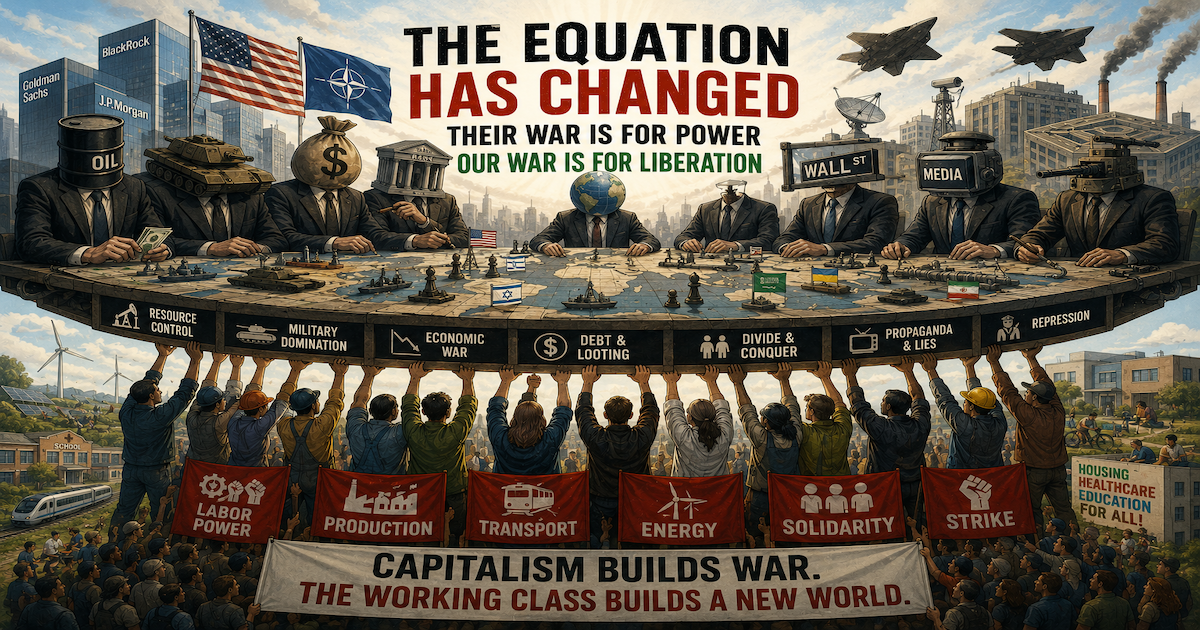
The war involving Iran, the United States, and Israel has entered a new phase in recent days. Iran has directly targeted Israel with missile strikes. The fronts in Lebanon, Yemen, and the Persian Gulf are becoming active, and forces whose disarmament and dissolution were until recently being discussed have, after a period of war and ceasefire, once again become part of the regional deterrence equation.
For weeks and months, the United States and Israel pursued this war with a clear objective: a large-scale military operation aimed at imposing an immediate change from above, or at the very least forcing the Islamic Republic to retreat, abandon its regional military influence, sever its ties with proxy forces, and accept new conditions dictated by the Western powers. Yet the events of recent days indicate that this equation no longer functions in the way it once did.
At the same time, Donald Trump, who until recently spoke of destruction, surrender, and maximum pressure, now appears in the role of mediator, calling for an immediate halt to the fighting and warning against the expansion of the conflict. More importantly, the U.S. government, which until yesterday demanded an end to the regional role of the Islamic regime, is now urging Israel to refrain from attacking Lebanon and from actions that could reignite regional fronts.
This is not merely a change in tone. It reveals that the war has reached a point where its original objectives no longer correspond to its actual consequences. The demand for disarmament and capitulation has given way to attempts at containing the crisis. The goal of eliminating proxy forces has been replaced by efforts to prevent them from entering the war. The attempt to impose political will has become an effort to prevent the collapse of control over events.
This does not mean that the Islamic Republic has achieved victory. It does mean that the project of imposing the will of the United States and Israel has encountered a serious obstacle. The events of recent days are not simply a series of military incidents; they are signs that the war is approaching a strategic impasse and that assumptions which appeared self-evident at the beginning of the conflict are no longer self-evident.
The war has reached a stage where it proceeds not according to its original goals but according to the new limitations it has imposed upon all parties. This shift signals the emergence of new conditions in the region and in the world. These developments are among the first global signs of an era in which overwhelming military power alone is no longer capable of imposing political will; an era in which energy routes, asymmetric warfare, regional networks, and the capacity to disrupt economic reproduction have become as important as aircraft carriers and strategic bombers.
And it is precisely at this point that a larger question confronts us:
If the most powerful states and armies in the world must bomb refineries, close ports, paralyze energy networks, and target the arteries of production in order to bring a bankrupt and reactionary regime to its knees, then where does real power actually reside?
The answer to this question leads us from their war to our war.
Their War and Our War
This war has once again revealed a reality hidden beneath mountains of nationalist propaganda, militarism, and interstate rivalry. When the most powerful armies in the world seek to bring defiant states within this reactionary order to their knees, they ultimately arrive at the same point: stopping production, cutting energy supplies, destroying infrastructure, paralyzing transportation, and disabling the arteries of economic reproduction.
The states engaged in war—from Russia and Ukraine to the United States, Israel, and Iran—bomb refineries, close ports, destroy power grids, and target strategic industries in order to paralyze society. They do so because they know better than anyone where real power lies.
Real power does not reside in palaces, military headquarters, or war rooms. Real power is in the hands of those who set society in motion every day: workers in steel, oil, petrochemicals, transportation, ports, railways, electricity, mining, and the key industries upon which society depends. They stand at the heart of the very process upon which the entire economic and military machine rests. Yet beyond the war of states, another war is taking place: the war of classes.
States fight to control resources and markets. The working class fights to free itself from exploitation, war, poverty, and domination. This is not our war. This is a conflict among capitalist powers over power, influence, markets, energy routes, and geopolitical position
The states engaged in this reactionary war derive their strength from destruction, devastation, and killing—from capital, armies, police forces, and the machinery of death. In the class struggle, however, we derive our strength from labor, production, social cooperation, and from the position we occupy at the heart of society’s reproduction. What military strategists seek through destruction, the working class can accomplish through organized revolution and mass strike. What states attempt to achieve through bombs, missiles, and devastation, the organized working class can achieve through its own immense revolutionary power.
If they seek to stop the wheels through bombardment, we can stop the wheels without destruction. If they destroy infrastructure in order to force one another into submission, we can challenge the entire machinery of exploitation through our collective powe.
Their war is a war for power and domination.
Our war is a war for human liberation.
Turn the wars of capitalist powers into a struggle against capitalism.
June 9, 2026
Internationalist Workers’ Organization
