
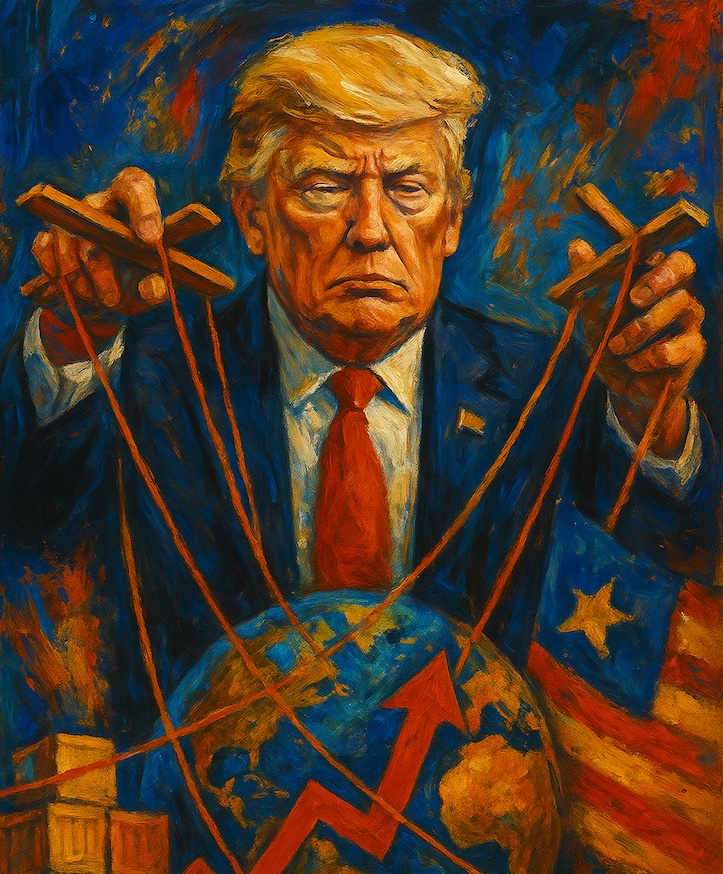
In the context of the historical crisis in the total reproduction of capital, Trumpism should be understood above all as a deliberate project advanced by a specific fraction of the American bourgeoisie. The policies of the Trump administration were not merely the reflection of Donald Trump’s personality or a form of superficial populism. Rather, they represented a structural response to the disintegration of the liberal global order.
This political-economic orientation reflects the interests of billionaire elites and industrial lobbies seeking to restore the hegemony of the U.S. dollar and maintain American leadership within an emerging global order.
Contrary to the repetitive claims of state-aligned commentators, academic Marxists and certain left parties, Trumpism is neither a form of mercantilism nor a directionless populist phenomenon. Instead, Trump’s economic policies represent a deliberate restructuring of the rules of international trade through tariff escalation, weakening of multilateral institutions and redistribution of industrial and security costs toward both allies and rivals.
In this sense, Trumpism rests on a structured program aimed at managing the deep crisis of capital accumulation through “controlled instability” and the partial reconstruction of the material foundations of the global order.
The Collapse of the Vienna Order
World War I (1914–1918) shattered the system of imperial competitive capitalism, leading to the collapse of four major empires and the disruption of colonial and market relations.
Within this context of declining British dominance and the erosion of the Vienna system, the October Revolution of 1917 represented not only an ideological challenge but also a sign of a profound crisis in the reproduction of capitalist power.
The ruling classes attempted to restore stability through protectionist policies such as the Smoot-Hawley Tariff of 1930, a partial return to the gold standard and the repression of revolutionary movements. Yet the fragility of global markets and mounting state debt culminated in the Great Depression.
The Great Depression
The crisis of 1929–1933, marked by massive bank failures and a collapse of industrial production, intensified the contradictions of capitalist accumulation.
World War II emerged largely as a consequence of this economic breakdown and the escalating rivalry among imperialist powers.
The post-war Bretton Woods Conference (1944) established a new dollar-centered international monetary order. Institutions such as the International Monetary Fund and the World Bank were created, and the expansion of global trade was presented as a mechanism for stabilizing capitalism.
Neoliberal Disorder and the 2008 Crisis
The Bretton Woods system survived until the early 1970s, when the United States abandoned the gold convertibility of the dollar in 1971 amid declining profitability and persistent trade deficits.
This shift marked the rise of neoliberalism. Governments under Reagan and Thatcher responded to the crisis of stagflation through financial deregulation, privatization and a direct assault on working-class living standards.
Yet the global financial crisis of 2008 demonstrated that financialized capitalism itself could no longer contain the contradictions of accumulation.
Trumpism and the Historical Crisis of Capitalist Reproduction
Trumpism must therefore be understood as an expression of a transformation within the global capitalist order under the pressure of a historical crisis in the total reproduction of capital.
This crisis signifies a turning point at which not only profit rates or accumulation cycles are disrupted, but the very possibility of reproducing the entire structure of capitalist relations – including commodity production, labor reproduction, ideological hegemony and institutional forms of social organization – comes into question.
The crisis of 2008 marked a decisive transition from a structural crisis of accumulation toward a broader historical crisis of capitalist reproduction.
Outlook
Trump repeatedly argued that the United States should no longer “pay for global stability.” His demands for greater burden-sharing among allies and for the return of industrial production to the United States reflect a strategy aimed at restoring dollar hegemony within the conditions of a systemic crisis.
Trumpism thus rests both on the collapse of the neoliberal order and on intensifying geopolitical and economic rivalry with powers such as China and Russia.
The central question remains whether this strategy of “controlled restructuring” can restore American hegemony or whether it will deepen the fractures of the global order.
May 2, 2025
IWO