
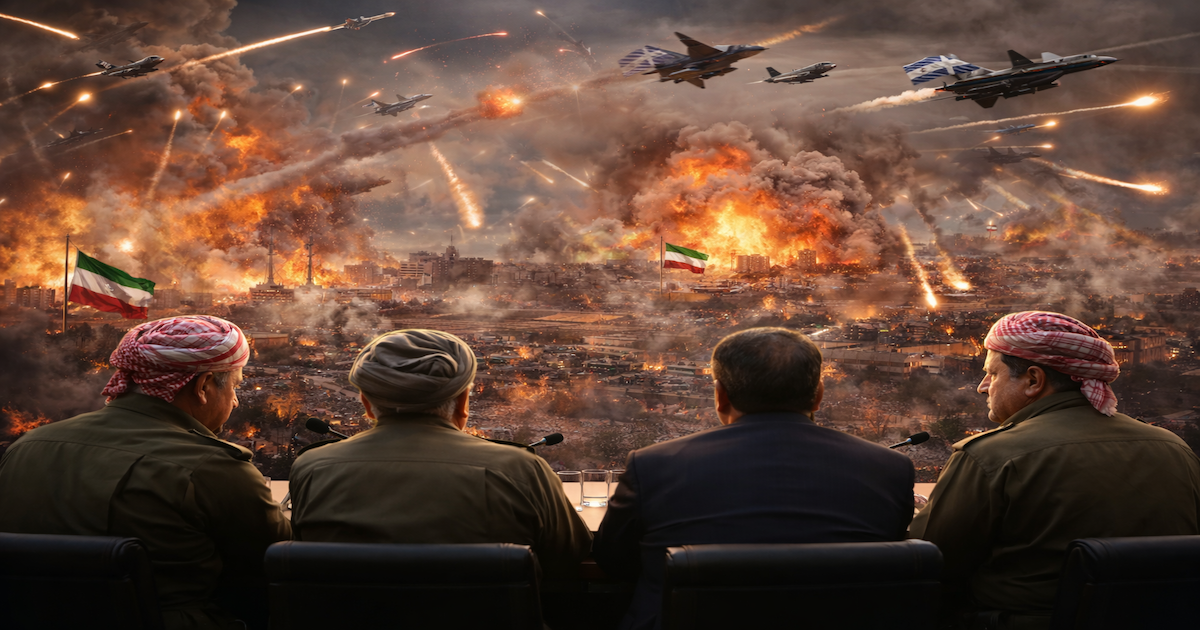
The ongoing war has entered a new phase. The scenario of a lightning war on which the United States and Israel had counted did not produce the expected results. Their calculation was clear: by assassinating the political leadership and military commanders of the Islamic Republic and destroying its missile infrastructure, the regime’s war machine would be paralysed within the first hours and the balance of power would quickly shift. But this plan failed. Neither did the structure of the Islamic regime collapse rapidly through political assassinations, nor was its missile capability eliminated at once. The counter-attacks and the geographical scope of targets now under fire across the region demonstrate that the project of a “short and precise war” has reached a dead end.
This deadlock reveals a simple truth: regime change in a country like Iran is impossible without ground forces. Yet after the experiences of Iraq and Afghanistan, the United States is unable to deploy its army in another large-scale ground war. At this point the familiar strategy of imperialism reappears: the creation of proxy forces and the transfer of war into the society of Iran itself.
Within this framework, sections of the exiled opposition or armed ethnic forces appear as potential instruments. The relative success of the United States, Israel and regional powers in presenting the monarchist current as a political alternative has played a role in the power game. Yet the “Pahlavi alternative”, despite its usefulness in this political narrative, is not operational in the concrete conditions of the present moment. Consequently, Washington and its allies are seeking to construct a proxy ground force by mobilising ethnic and tribal parties and other organisations capable of acting as foot soldiers and assisting in transferring the regional crisis into Iran.
This follows a pattern already seen in Iraq, Libya and Syria: when direct war fails to deliver rapid victory, the targeted country becomes an arena for competing proxy forces, militias and projects of fragmentation and destabilisation. If ethnic nationalist parties or organised opposition forces submit to becoming instruments of foreign powers, the situation will inevitably move toward civil war. For imperialist powers the objective is clear: to extricate themselves from the quagmire of direct war and relocate that quagmire inside the country itself.
Yet this development is not merely a military tactic; it is part of a deeper crisis affecting the global capitalist order. Energy crises, geopolitical rivalry and the historical crisis in the reproduction of capital are pushing major powers toward regional wars and conflicts. Under such conditions countries like Iran become testing grounds for these rivalries, while their populations bear the primary cost.
The working class and the oppressed in Iran must not fall into this trap. Neither the Islamic regime, which has ruled through repression and religious authoritarianism, represents the people, nor the imperialist projects that attempt to engineer the country’s future from outside. Turning Iran into a battlefield for proxy war would mean the destruction of social infrastructure, deepening poverty and pushing society toward civil war.
The task of progressive forces and the workers’ movement is therefore clear: to expose the project of proxy war and resist it. Workers and peoples of the region have nothing to gain from this war. What stands before them is a choice between two forms of reaction: domestic reaction and imperialist reaction.
The real answer can only lie in the formation of an anti-war movement based on internationalism — a movement that serves neither authoritarian states nor imperialist powers. Only through the independent organisation of the working class and cross-border solidarity among workers and the oppressed can the projects of war, fragmentation and instability be resisted.
Imperialist war and proxy war are two sides of the same coin. Confronting them requires a force that transcends national borders and the power games of states: working-class internationalism and organised anti-war resistance.
Towards anti-war and anti-capitalist centres
Against neo-fascism and war-mongering nationalism – against reactionary war
Long live the internationalist solidarity of the working class
5 March 2026
Internationalist Workers’ Organization