
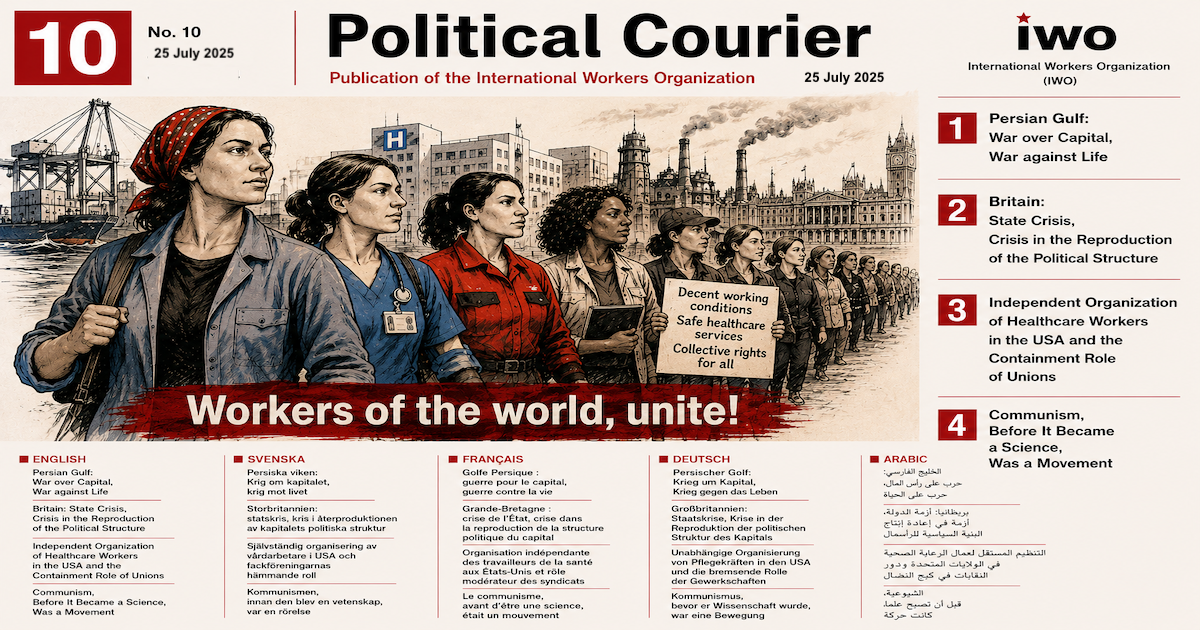
The Persian Gulf: A War for Capital, a War Against Life
The war in the Middle East has entered a new and far more dangerous phase. Following the Twelve-Day War, the Forty-Day War, and a series of fragile ceasefires, repeated U.S. strikes against southern Iran have made the prospect of the conflict spreading across the entire Persian Gulf more real than ever before. Bahrain, Kuwait, Iraq, the Red Sea, and other countries hosting U.S. military forces have effectively become part of the geography of this war.

The possibility of renewed Israeli participation in joint military operations, together with an increased focus on ports, islands, and critical infrastructure in southern Iran, indicates that the conflict may move beyond reciprocal military strikes toward direct control over strategic energy hubs, maritime routes, and key infrastructure.
Should the war reach this stage, the issue will no longer be limited to the bombing of a handful of military installations. What military commanders and governments describe as “strategic control” means, for millions of people, the destruction of cities, the shutdown of workplaces, mass displacement, and the militarization of the very spaces where people work and live their everyday lives.
Two weeks ago, we argued that the conflict in the Persian Gulf is fundamentally a war over the control of capital circulation, energy routes, and the distribution of global profits among competing powers. Recent developments demonstrate even more clearly how the competition between capitalist powers over capital accumulation and spheres of influence inevitably turns into a war against the conditions of social life itself. Ports, refineries, power stations, railways, transport networks, factories, and service facilities are not merely “strategic targets.” They embody the accumulated labour of successive generations of the working class and constitute the material foundations upon which the production and reproduction of social life depend.
When a refinery or a port where workers earn their livelihood is bombed, workers lose far more than their jobs. The closure of production facilities throws thousands of families into unemployment, deprives them of income, drives up the cost of living, and forces many to abandon their homes. Children are denied education, patients lose access to medical care, and neighbourhoods and cities built through generations of collective labour face evacuation and destruction. The victims of war are not only those buried beneath the rubble. The unemployed worker, the displaced family, and every person deprived of water, electricity, medicine, or shelter are equally victims of the same war.
Yet the targeting of workplaces and living spaces extends beyond the destruction of buildings and machinery. The devastation of factories, ports, and neighbourhoods disperses workers, tears apart the social bonds forged in workplaces and communities, and weakens their collective strength. The warring powers destroy precisely those places where both the reproduction of capital and the capacity of the working class to assemble, communicate, organise, and resist are rooted.
The United States and Israel justify this destruction in the name of “security,” “deterrence,” and “freedom of navigation.” But the security they seek to protect is the security of oil tankers, naval fleets, financial markets, and the uninterrupted circulation of capital—not the security of the people living under bombardment. Human life matters only insofar as it does not obstruct profit or geopolitical dominance. No bombing campaign has ever delivered freedom, justice, or prosperity. Every missile that strikes a port, a power station, a bridge, or a refinery destroys part of the accumulated social labour of our class and sets fire to society’s future.
The Islamic Republic, on the other side of this conflict, is no defender of the people. The same regime that has spent decades diverting society’s resources toward militarisation, repression, and regional power struggles is now attempting once again to shift the costs of war and destruction onto the shoulders of workers. Under the banner of “defending the homeland,” every protest against unemployment, inflation, collapsing public services, or unpaid wages can be suppressed.
External bombardment and internal repression may be carried out by opposing forces, but in the lives of working people they produce the same result: deeper poverty, intensified security discipline, the silencing of independent working-class voices, and the expansion of the machinery of repression and execution.
This war is no longer merely a regional conflict. The Persian Gulf has become one of the principal fault lines in the crisis of the global capitalist order. Washington’s warnings to China and Russia against any form of intervention indicate that a prolonged conflict could draw the rivalry among the major powers into a new and more dangerous phase. The United States seeks to preserve its dominance over global energy routes and international trade. China aims to secure its energy supplies and commercial interests. Russia is determined to prevent any further erosion of its regional influence. Europe, too, cannot escape the economic and security consequences of this crisis. None of these powers has entered the arena to defend the freedom of the peoples of the region. All are fighting to preserve or redefine their share of the global order of capital.
War is itself a product of the deepening crisis of the capitalist order, while simultaneously serving as an attempt to manage that crisis. Yet this attempt exhausts not only society but also the states engaged in the conflict. In Iran, divisions within the ruling establishment over negotiations, the continuation of the war, and the management of the crisis have become increasingly visible. In the United States, the war has become part of the struggle over executive authority, the role of Congress, and efforts to contain Donald Trump. In Israel, Netanyahu’s government remains under mounting pressure from its crisis of legitimacy, internal coalition conflicts, and continuing social protests. War was supposed to strengthen and unite these governments. Instead, it has become another force deepening their political crises.
None of the parties to this conflict has achieved its declared objectives. The United States has failed to force the Islamic Republic into submission. The Islamic Republic has failed to consolidate its position. Israel has failed to obtain the security it promised its population. Rather than resolving the crisis, the war has become a mechanism for prolonging and expanding it. This deadlock is not confined to the Middle East. It is one expression of a global order in crisis—an order that increasingly relies on militarisation, destruction, and the redivision of spheres of influence in order to preserve and reorganise the accumulation of capital.
Should the war continue to expand, unemployment, displacement, and destruction will expand with it. Should a temporary ceasefire be imposed, capital will immediately move to seize the opportunities created by reconstruction. What is destroyed today by bombs will tomorrow be rebuilt through privatisation, cheap labour, precarious employment contracts, and even harsher forms of labour discipline. Capital profits from the production of weapons, and it profits once again from rebuilding the devastation those very weapons create.
Yet reconstruction is not merely a new field for capitalist profit. It is also a new terrain of class struggle. Who will bear the costs of reconstruction? Who will decide its priorities? Who will rebuild the infrastructure, under what wages, and under what conditions of employment? The ruling powers will inevitably confront workers’ resistance against dismissals, wage reductions, privatisation, and intensified exploitation.
The working class is not merely the victim of this war. It is the social force upon whose labour this entire order rests, and the only social force capable of transforming it. The fact that, in wartime, the workplaces and living spaces of our class become military targets, while in peacetime the resistance of that same class becomes the principal obstacle to the programmes of capital, demonstrates its central historical role in the present crisis of capitalism.
The remaining articles of this issue will be available here soon
